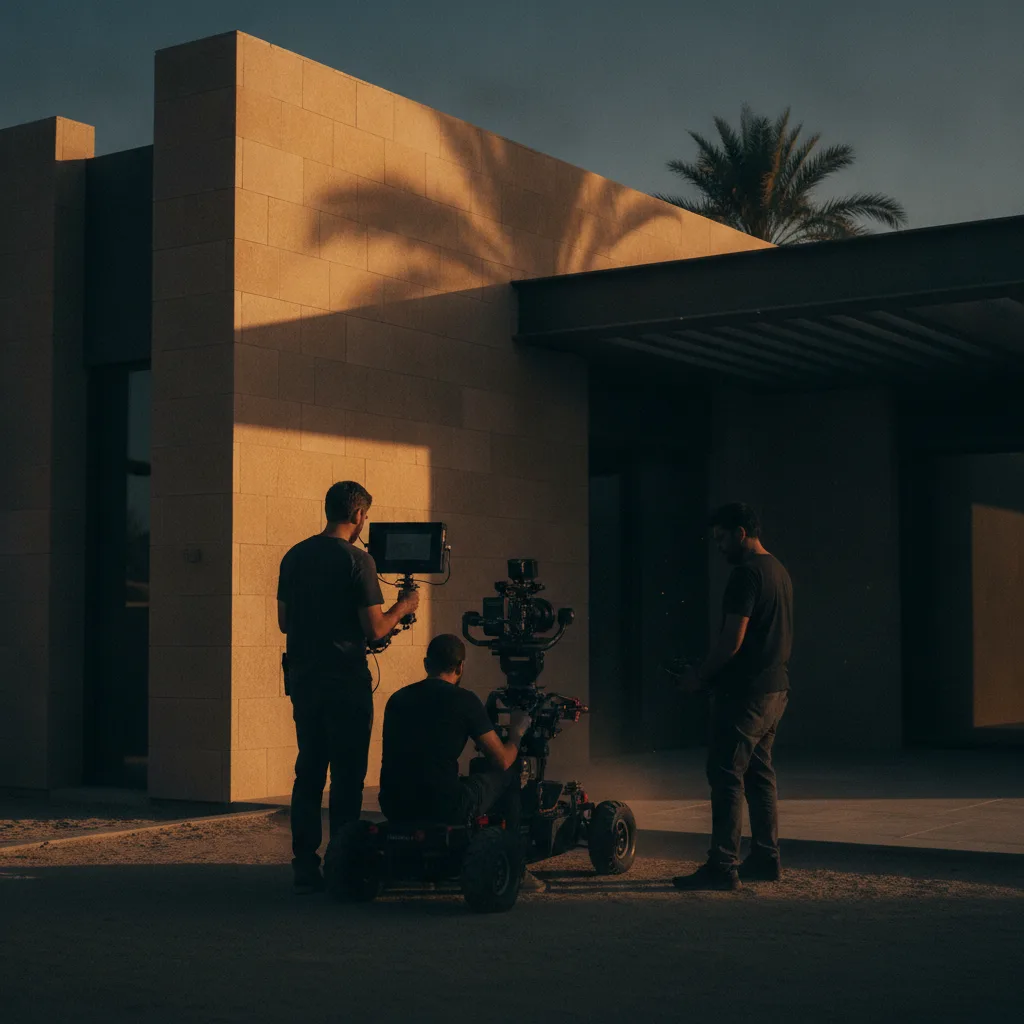
Evaluating a luxury brand video production studio in the GCC requires auditing three technical capabilities: sensor dynamic range (14 to 17 stops via ARRI Alexa 35 or Sony Venice 2) to capture intense Middle Eastern daylight alongside shadowed interiors, an ACES or LogC4 color pipeline for authentic material textures, and direct operational handling of Civil Aviation Authority drone permissions and Ministry clearances. Generic production teams using prosumer mirrorless setups regularly fail under high-contrast desert sun and strict regional lead times. Choosing the right crew ensures your multi-million-dollar development or five-star resort is framed with cinematic precision.
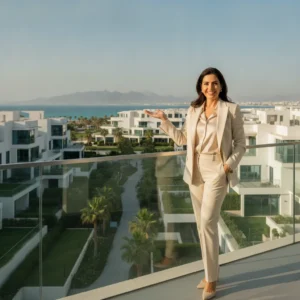
Standing on the cliffside terrace of a private villa in Muscat Bay at two o’clock in the afternoon, the light hitting the Gulf of Oman is blinding. Limestone facades gleam white under direct sun, while inside the open-plan lounge, hand-finished walnut cabinetry, Italian travertine floors, and shaded lounge seating sit in deep shadow. A standard commercial video crew using prosumer gear faces an impossible compromise: expose for the sunlit ocean and turn the luxury living space into a black silhouette, or expose for the interior decor and wash out the coastal view into a lifeless white glaze.
Selecting an experienced luxury brand video production studio resolves this optical conflict through cinema-grade sensor architecture, high-output continuous lighting, and strict color management. For marketing directors, developers, and hotel general managers overseeing flagship visual assets across Oman, Iran, and the GCC, hiring an under-equipped crew risks delivering compromised footage that fails to engage high-net-worth buyers. This guide details the camera systems, lighting configurations, Omani regulatory requirements, and budget benchmarks needed to audit prospective production partners.
Technical Standards of a Luxury Brand Video Production Studio: Sensors and Color Science
The visual gap between standard corporate videography and true luxury brand video production comes down to hardware capabilities and color science. High-end property interiors and coastal hospitality resorts across Muscat, Dubai, and Isfahan feature extreme contrast ratios that lower-tier cameras simply cannot record.
Standard 8-bit or 10-bit mirrorless cameras offer between 8 and 11 stops of usable dynamic range. Exposing for an indoor living room or hotel lobby causes exterior window views to clip completely, destroying views of infinity pools, private beaches, and landscaped grounds. Exposing for the sunlit exterior instead leaves interior architectural details hidden in dark, noisy shadows. Elite cinema camera packages command daily rental rates between $800 and $1,600 per package precisely because their hardware handles extreme contrast without degrading the image.
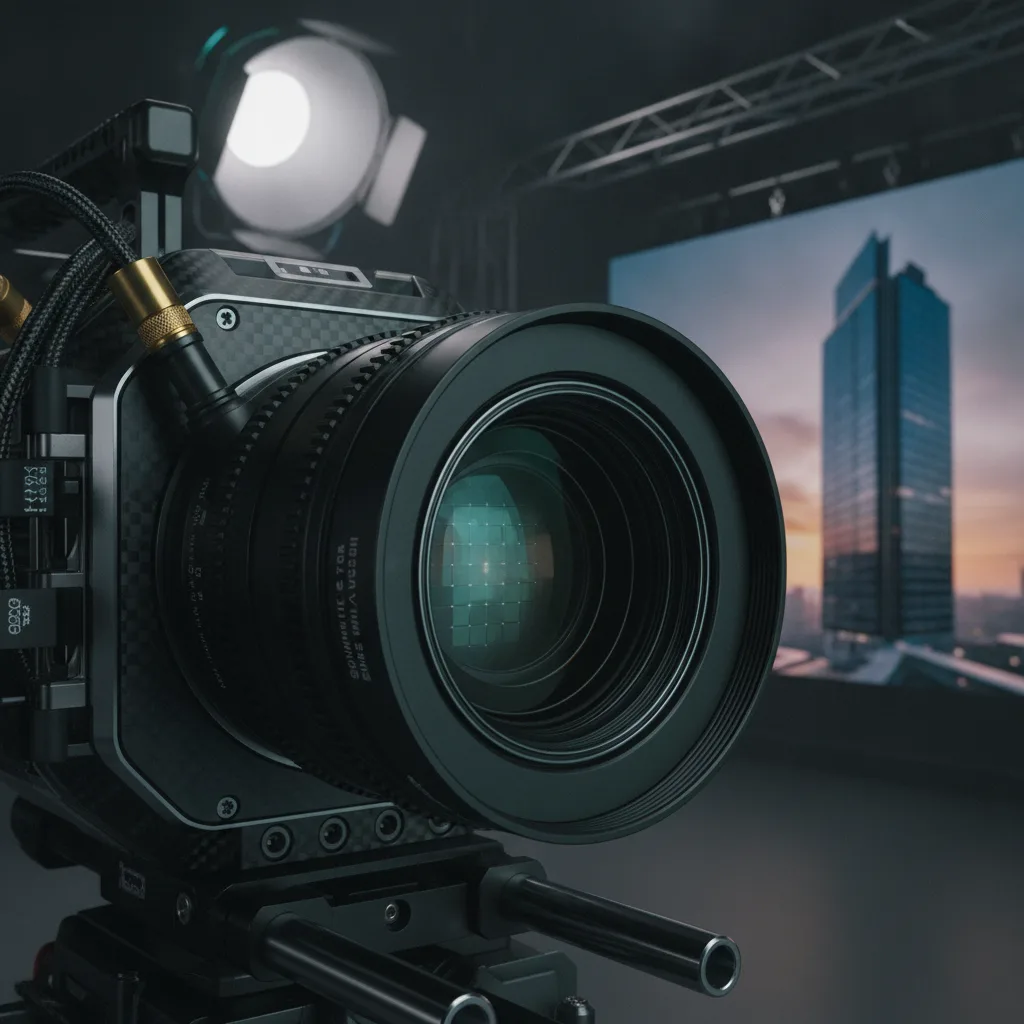
Capturing luxury hospitality and architectural interiors accurately requires digital cinema sensors with at least 13 to 14 stops of dynamic range, while flagship cinema bodies achieve up to 17 stops. Three primary camera platforms meet this requirement for high-end GCC campaigns.
For maximum highlight retention, the ARRI Alexa 35 utilizes a Super 35 4.6K sensor to yield 17 stops of dynamic range. Its LogC4 color science prevents direct sunlight highlights on glass or white stone from clipping, while retaining organic skin tones for on-camera talent. In contrast, Sony’s Venice 2 incorporates a full-frame 8.6K sensor with 16 stops of dynamic range and dual base ISO (800/3200). This setup excels in dimly lit hotel ballrooms, spa facilities, and mood-lit lounge spaces without introducing digital sensor noise. Meanwhile, the RED V-Raptor provides 8K multi-format recording at high frame rates, delivering sharp imagery for high-speed tracking shots, helicopter aerials, and cinematic architectural videography.
Camera hardware is only half of the post-production equation. The color pipeline determines how materials like polished brass, dark timber, and natural marble appear on 4K OLED screens and commercial displays. Typical corporate video workflows rely on generic Rec.709 color look-up tables that distort fabric tones, shift skin colors toward artificial orange, and flatten subtle architectural textures. Elite production studios route all footage through standardized Academy Color Encoding System (ACES) or native LogC4 workflows. This scientific color management maintains true visual fidelity for brushed metal, woven silk, glaze-tiled facades, and natural skin tones across all display environments.
Architectural Lighting Design: Controlling Dynamic Range on Location
High sensor dynamic range provides the recording latitude needed to capture broad contrast, but deliberate lighting design builds depth, dimensional shape, and mood across architectural spaces. Relying strictly on natural sunlight in destinations like Muscat or Isfahan leads to harsh shadows, shifting color temperatures, and unstable interior exposures as the sun moves across the sky.
Professional film crews do not rely on small, camera-mounted lights or portable speedlights. Instead, they deploy high-CRI (Color Rendering Index) continuous cinema fixtures capable of competing directly with Middle Eastern daylight. To balance bright outdoor views with shaded indoor architecture, crews position heavy-duty HMI (Hydrargyrum Medium-arc Iodide) units alongside high-output LED arrays, such as ARRI SkyPanels and Aputure 1200d fixtures.
Without controlled interior lighting, even a 17-stop cinema sensor cannot bridge the exposure gap between Middle Eastern daylight and dark interior architecture.
The primary goal when lighting luxury property interiors is exposure ratio control. The Director of Photography and gaffer increase interior ambient light levels until the indoor exposure falls within two stops of the exterior sunlight. Pushing daylight-balanced continuous fixtures through large diffusion frames placed outside floor-to-ceiling windows or high archways produces soft, natural illumination. This preserves outdoor scenery while revealing the grain of imported timber, hand-carved plasterwork, and subtle room textures without creating obvious artificial glare.
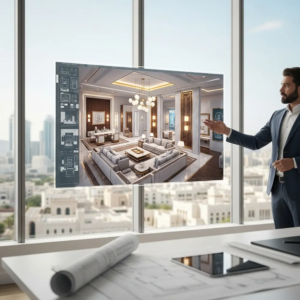
Art Sun Studio organizes its operations across six dedicated in-house teams: Design, Film, Graphic Design, Social Media, Web Design, and AI. This multidisciplinary structure allows our film crews to pair architectural videography with 3D architectural animation and digital pre-visualization, helping directors map light placement and solar angles long before physical production equipment arrives on site.
Operational Blueprints: Coastal Hospitality and Heritage Restorations
Geographical, architectural, and climatic conditions dictate how a luxury brand video campaign is planned and executed across different GCC locations. Two distinct technical blueprints illustrate how experienced film teams handle these contrasting environments.
Coastal Hospitality Production Blueprint: Muscat Bay, Oman
Filming a beachfront luxury resort in Muscat requires balancing direct midday sun off sea waters while capturing smooth indoor-outdoor living transitions. Pre-production starts four weeks prior to filming. Production is scheduled during the optimal climatic window between October and March to take advantage of clear skies and lower solar angles during sunrise and late afternoon. For regional campaigns in Salalah, filming shifts to the Khareef season (July through September) to highlight lush mountain scenery, waterfalls, and mist-covered landscapes.
The technical crew pairs an ARRI Alexa 35 with spherical cine prime lenses to manage direct lens flares. Across a four-day shoot, early mornings are reserved for Civil Aviation Authority cleared commercial drone maneuvers tracking arrival yachts and infinity pools. Midday schedules center on interior lighting builds, deploying high-output HMIs to illuminate master suites while maintaining the natural turquoise color of the ocean outside. Post-production applies an ACES color pipeline to preserve saturated water tones while keeping skin tones natural for featured talent.
Heritage Interior Production Blueprint: Isfahan, Iran
Documenting a restored Safavid-era boutique hotel or heritage caravanserai involves navigating delicate mirrorwork (Ayeneh-kari), intricate turquoise tilework, vaulted brick ceilings, and courtyard reflection pools. The main creative aim is capturing rich historical detail, intimate atmosphere, and material texture.
Because heritage properties are protected cultural sites, heavy light stands and high-heat fixtures cannot be leaned against antique walls or tilework. The production team uses lightweight, high-CRI LED light mats and soft tube fixtures concealed behind architectural arches and timber columns. Shooting spans three days during dawn, late afternoon, and twilight. The crew uses motorized sliders and compact camera rigs for slow, smooth movements. Lighting highlights the depth of hand-painted ceramics and water reflections, while color grading focuses on micro-contrast adjustments to emphasize rich blues, golds, and emerald greens without over-saturating historic materials.
Managing diverse creative demands across modern coastal developments and historic restorations requires structured operational control. Art Sun Studio executes every assignment through a transparent 6-step project workflow: Brief, Proposal, Concept, Production, Review, and Delivery.
Navigating GCC Logistics: Oman CAA Permits, Heritage Approvals, and Customs
Cinema equipment and creative vision cannot overcome administrative delays, missing paperwork, or confiscated gear. Operating a high-end commercial video team in Oman and the broader GCC requires strict compliance with regional aviation regulations, municipal permissions, and customs rules.
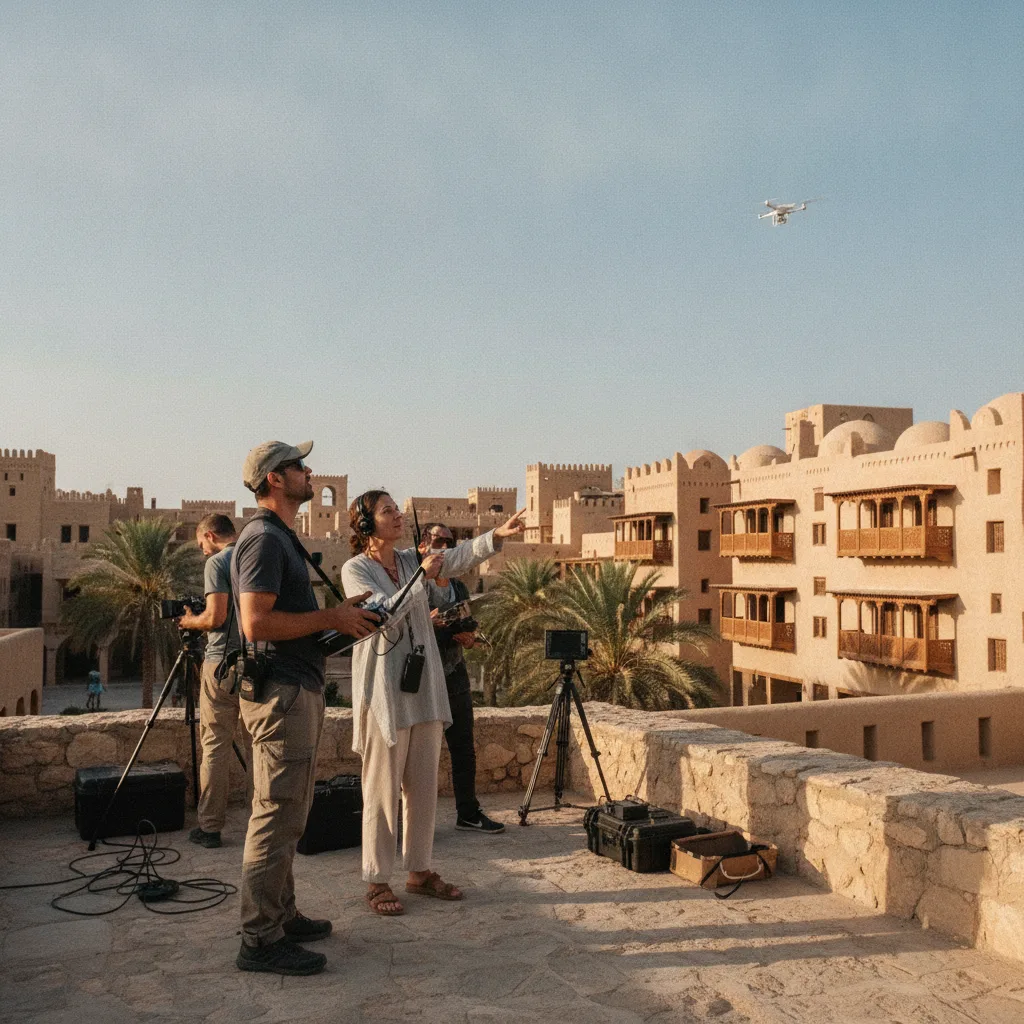
Commercial drone operations in Oman face strict regulatory oversight. Flying recreational drones as a tourist is strictly prohibited. Commercial aerial filming requires joint authorization from the Civil Aviation Authority (CAA) and Defense Authorities, requiring a mandatory lead time of 15 to 21 business days. Applications require licensed pilot documentation, exact flight coordinates, and local corporate sponsorship. Operating an unlicensed drone for commercial property shots risks immediate shutdown, financial fines, and equipment confiscation. CAA commercial drone clearances cost between OMR 150 and OMR 400 depending on location complexity.
Filming in public spaces across Muscat or within cultural heritage sites requires commercial filming permits from the Ministry of Heritage and Tourism (MHC), costing OMR 100 to OMR 350. Location access fees for heritage areas like Mutrah or Al Balad range from OMR 200 to OMR 800 per day. Iconic architectural sites, such as the Royal Opera House Muscat, charge daily access fees ranging from OMR 500 to OMR 2,000 and enforce a mandatory three-week advance application timeline.
Foreign film crews importing specialized equipment into Oman must also prepare for customs processing. Bringing camera gear into the country requires obtaining a General Filming Permit and paying a refundable customs deposit equal to 10% of the total equipment value. Omani customs holds this deposit until approximately 30 days after all gear has been re-exported out of the country.
Evaluating a Luxury Brand Video Production Studio: A Strategic Decision Matrix for Campaign Directors
Evaluating production budgets across the GCC requires separating social media content creation from cinema-grade brand campaigns. Attempting to execute a luxury real estate launch or hotel commercial on a basic corporate budget usually leads to clipped highlights, flat ambient lighting, and generic color grading.
Commercial video production costs across Oman and the GCC fall into three distinct pricing Tiers:
- Social Content & Short Promos (OMR 500 – OMR 1,500): Short promotional clips filmed on prosumer mirrorless cameras with minimal lighting setups and basic post-production turnarounds.
- Corporate & Brand Documentaries (OMR 2,000 – OMR 4,500): Multi-day corporate projects using mid-tier cinema cameras, small technical crews, standard filming permits, and Rec.709 color passes.
- Flagship Luxury Real Estate & Hospitality TVCs (OMR 5,000 – OMR 15,000+): High-end commercial campaigns using ARRI Alexa 35 or Sony Venice 2 camera packages, continuous HMI lighting trucks, licensed CAA drone operators, specialized Directors of Photography, ACES color grading, custom sound design, and localized bilingual scripts.
Choosing your key technical personnel directly impacts campaign costs and visual quality. Importing a senior foreign Director of Photography (DP) from Europe or North America to Muscat incurs daily rates between OMR 500 and OMR 1,100, plus flights, per diems, and hotel accommodations. Partnering with an established regional studio that employs experienced local DPs provides identical cinema hardware and visual execution at regional day rates of OMR 180 to OMR 350, while avoiding travel expenses and local permit friction.
Script localization represents another critical area where generic campaigns fail. Direct word-for-word translations from English into Arabic sound artificial and unconvincing to native audiences. Engaging high-net-worth GCC buyers requires scripts written natively in Gulf Arabic, capturing local cultural nuances and delivered by voiceover artists who communicate elegance and distinction.
To evaluate a potential production partner for your upcoming campaign, evaluate their capabilities against four strategic operational pillars:
- Camera Hardware and Optical Latitude: Verify that the studio owns or regularly deploys high-dynamic-range cinema platforms (ARRI Alexa 35, Sony Venice 2, or RED V-Raptor) offering 14 to 17 stops of dynamic range, rather than relying on 8-bit or 10-bit mirrorless bodies.
- Continuous Lighting Inventory: Ensure their equipment lists include high-CRI continuous light fixtures (HMIs, ARRI SkyPanels, Aputure 1200d) capable of balancing dark interior architecture against Middle Eastern sun.
- Regional Regulatory Handling: Confirm the studio directly manages local permissions, including Oman CAA drone licenses (15 to 21 business day lead times), MHC tourism clearances, site access fees, and customs deposit logistics.
- Native Bilingual Storytelling: Review their portfolio for culturally adapted Gulf Arabic scripting and professional native voiceover production rather than machine-translated scripts.
Art Sun Studio was founded in 2003 in Isfahan by creative director Ehsan Rezapour, who brings over 25 years of experience across filmmaking, photography, and visual design. The studio expanded physical operations to Dubai in 2018 and Muscat in 2020. Our specialized in-house teams handle native, non-machine-translated content production across English, Arabic, and Persian, ensuring high-end brand messaging resonates authentically with regional audiences.
Frequently Asked Questions
Why do standard corporate videos look cheap compared to global luxury hotel brand films?
Standard corporate videos rely on mirrorless cameras with limited dynamic range, unmanaged ambient light, and simple Rec.709 color profiles. This produces washed-out windows, dark interior shadows, and harsh skin tones. Luxury brand films use cinema sensors offering 14 to 17 stops of dynamic range, high-output continuous lighting to balance natural sun, and ACES color pipelines that preserve true material textures and natural skin tones.
How long does full pre-production, shooting, and post-production take for a GCC luxury hospitality film?
A flagship real estate or hospitality film requires six to nine weeks in total. This schedule includes three to four weeks of pre-production (scripting, location scouting, MHC approvals, and CAA drone permits), two to five production shoot days, and three to four weeks of post-production covering editing, sound design, ACES color grading, and native voiceover recording.
Can we fly our own drone for aerial shots over our resort in Muscat?
No. Unregistered drone flying by private individuals or tourists is illegal in Oman. Commercial drone filming strictly requires joint clearance from the Civil Aviation Authority (CAA) and Defense Authorities, which must be submitted through a licensed local sponsor 15 to 21 business days before filming.
Should we import a foreign Director of Photography or hire a regional studio?
Importing an international DP costs OMR 500 to OMR 1,100 per day plus airfare and hotel costs, and foreign crews often struggle with local regulatory processes. Partnering with an established regional studio in Muscat, Dubai, or Isfahan delivers equal cinema quality at regional DP rates (OMR 180 to OMR 350 per day) while ensuring all filming permits and venue clearances are handled smoothly.
Next Steps for Your GCC Luxury Campaign
Preparing a luxury real estate launch, resort commercial, or architectural project across Muscat, Dubai, or Isfahan requires aligning creative vision with technical precision and regulatory compliance. Contact Art Sun Studio, a full-service creative studio in Muscat, Dubai, and Isfahan, to review our architectural cinema portfolio and schedule an initial discovery call for your project.