Property developers in Muscat and Isfahan can shorten sales cycles by 2 to 4 months and increase off-plan pre-sale conversion rates by 25% to 40% using realistic digital visual production. Implementing high-fidelity 3d animation solutions for real estate converts complex CAD drawings into cinematic flythroughs, isometric cutaway floor plans, and interactive WebGL unit selectors that establish investor confidence. Before excavation equipment arrives on site, real estate companies across Oman and Iran can lock in pre-construction cash flow, secure non-refundable deposits, and fulfill local regulatory requirements using verifiable visual evidence.
A plot of undeveloped land in Al Mouj or Sultan Haitham City sits quiet under the mid-day heat. Architectural blueprints lie spread across a boardroom table, but two-dimensional vector lines fail to convey ceiling heights, natural sunlight patterns, or luxury interior finishes to prospective investors. Cross-border buyers reviewing project pitch decks on mobile devices across the GCC require visual proof before committing capital to pre-construction releases. Extended buyer hesitation stalls sales velocity and inflates land holding costs.
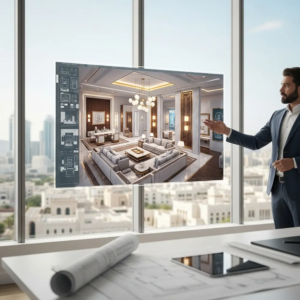
Static blueprints leave too much to the buyer’s imagination, creating hesitation that stalls pre-sales. High-fidelity 3D assets replace flat drawings with exact spatial previews, showing buyers precise layouts, natural light, and material finishes before ground is broken. This clarity reduces sales drop-off during off-plan presentations and gives commercial teams concrete evidence to lock in early buyer deposits.
Evaluating 3D Animation Solutions for Real Estate: ROI and Regional Market Impact
The global 3D rendering market reached $2.25 billion in 2026, according to the Intwopixel 3D Visualization Global Industry Report, with real estate operating as its primary commercial sector. Over 72% of urban real estate firms now integrate 3D visualization into off-plan property marketing campaigns. This industry transition reflects concrete financial metrics across pre-construction marketing operations.
Data from the 2026 TWOBUILD Real Estate Visualization ROI Study shows that property developers using photorealistic 3D visualization achieve 25% to 40% higher pre-sale rates prior to construction mobilization. Giving buyers direct visual clarity early in their decision process reduces average sales cycles by 2 to 4 months. Removing spatial ambiguity enables sales agents to resolve buyer concerns long before site groundwork begins.
In regional real estate markets across Oman and Iran, investor engagement relies heavily on mobile channels. High-net-worth investors considering an off-plan residential unit in Muscat or a multi-family commercial build in Isfahan inspect project deliverables primarily on smartphones and tablets. Research from the National Association of Realtors and Redfin Analytics in 2025 indicates that property listings and pre-sale launches featuring interactive 3D walkthroughs record an 85% higher conversion rate and up to a 130% rise in digital user engagement compared to static brochures.
In off-plan real estate, visual accuracy directly impacts buyer trust. Offshore rendering teams that lack Middle Eastern market experience often produce visual assets containing wrong tree species, incorrect sun trajectories, or unrepresentative building materials. Genuine regional CGI requires accurate solar path modeling for the Persian Gulf and Iranian plateau, native landscaping flora such as date palms and local shrubs, and specific marble, stone, and plaster textures common to contemporary Omani and Persian architecture. When visual assets accurately match local conditions, off-plan visualization becomes a dependable tool for securing early investor capital.
Matching 3D Animation Solutions for Real Estate to the Property Funnel
Selecting 3d animation solutions for real estate requires matching the visual asset to the buyer’s decision point. Spending an entire marketing budget on a single long promotional video can leave digital performance channels underfunded, while relying only on static renders limits user interaction. High-converting property launches distribute specialized visual deliverables across distinct customer touchpoints.
The NoTriangle Studio Global CGI Pricing Guide for 2026 benchmarks global pricing for architectural 3D animation between $2,000 and $18,000 per finished minute, while static 3D CGI hero renders cost between $250 and $5,000 per view. Aligning formats with specific sales stages ensures optimal returns on production spend.
- Cinematic 3D Flythrough Animations: Running between 60 and 90 seconds, these cinematic assets combine full architectural geometry, natural lighting shifts, depth of field, and sound design. They serve as primary visual assets for private investor galas, project web portals, and international sales presentations. Cutdown edits of 15 to 30 seconds provide high-converting media for Instagram reels, TikTok ads, and direct investor outreach on WhatsApp.
- Isometric 3D Cutaway Floor Plans: Moving beyond 2D CAD layouts, isometric floor plan renders present complete spatial volumes showing furniture placement, flooring materials, and room proportions. Placing 3D cutaways on website unit selection pages helps non-technical buyers evaluate interior layouts immediately, accelerating lead inquiries.
- Interactive WebGL Unit Selectors and Masterplan Explorers: These real-time 3D web applications allow prospective buyers to rotate entire building structures, filter inventory by floor level or layout type, analyze sunlight orientation, and take virtual unit walkthroughs inside a standard web browser. The 2025 Narsun Studios Middle East PropTech Report noted that off-plan launches utilizing virtual sales centers and interactive masterplan explorers achieve 60% to 70% inventory pre-bookings prior to site mobilization.
Deploying short social media video reels for lead generation, WebGL unit selectors for online exploration, and cinematic flythroughs for final pitch meetings creates a structured digital sales machine.
Navigating Off-Plan Regulations in Oman and Buyer Risk in Iran
Inside a sales gallery on Chaharbagh Avenue in Isfahan, a buyer reviews a pre-sale contract for an apartment block. High domestic interest rates and historical project delivery delays across the city have made buyers cautious about signing pre-construction (pish-foroush) agreements based on simple line drawings. Buyers demand clear visual proof before releasing deposit funds.
Photorealistic interior walkthroughs and structural 3D flythroughs act as effective risk-reduction tools in Iran’s pre-sale environment. By detailing exact layout dimensions, ceiling clearance, window orientation, and material specifications, developers establish transparent specifications that reassure skeptical buyers and secure early capital.
In Muscat, master-planned urban expansions such as Sultan Haitham City and Integrated Tourism Complexes (ITCs) rely heavily on securing pre-sales from foreign and regional GCC investors. Legal analysis by Dentons regarding Oman’s Royal Decree 79/2025 (Law Regulating Real Estate) and Royal Decree 56/2026 (New Real Estate Registry Law) emphasizes that off-plan developers must register every unit in the Preliminary Real Estate Registry and deposit buyer payments into licensed project escrow accounts. Escrow drawdowns are unlocked only as verified construction milestones are reached. Accurate 3D architectural renders validate architectural claims against registered plan filings, protecting developers against regulatory disputes when transferring units at completion.
Submitting precise 3D visualizations during early planning stages also speeds up municipal approvals. The 2026 Shapespark AEC Visualization Study demonstrated that incorporating photorealistic 3D visualization into municipal planning documentation reduced municipal review cycles by 37%, saving developers roughly 7 weeks of administrative waiting time before site groundbreaking.

Worked Scenario: From CAD Blueprints to Interactive Sales Gallery
Consider a luxury residential developer launching a seaside development within an Integrated Tourism Complex in Muscat. Fast pre-sale velocity is required to satisfy construction lender conditions and release escrow drawdown funds before setting foundation pilings.
Rather than spending tens of thousands of OMR to construct, furnish, and maintain a physical mock-up apartment on site, the developer adopts a digital visual strategy. Production shifts directly from technical architectural data to interactive sales presentation platforms without physical construction delays.
The production process begins with technical asset intake. The development team supplies complete REVIT models, CAD floor plans, elevation sheets, site landscape plans, and interior material schedules. Enforcing a strict design freeze at this initial stage locks building geometry, eliminating expensive re-rendering cycles later in production.
Next, 3D artists construct digital environments incorporating precise local sun vectors, water reflection shaders, and regional coastal plant models. The production team delivers a 90-second hero cinematic flythrough, isometric cutaway floor plans for each unit layout, and a lightweight WebGL unit explorer optimized for quick mobile loading.
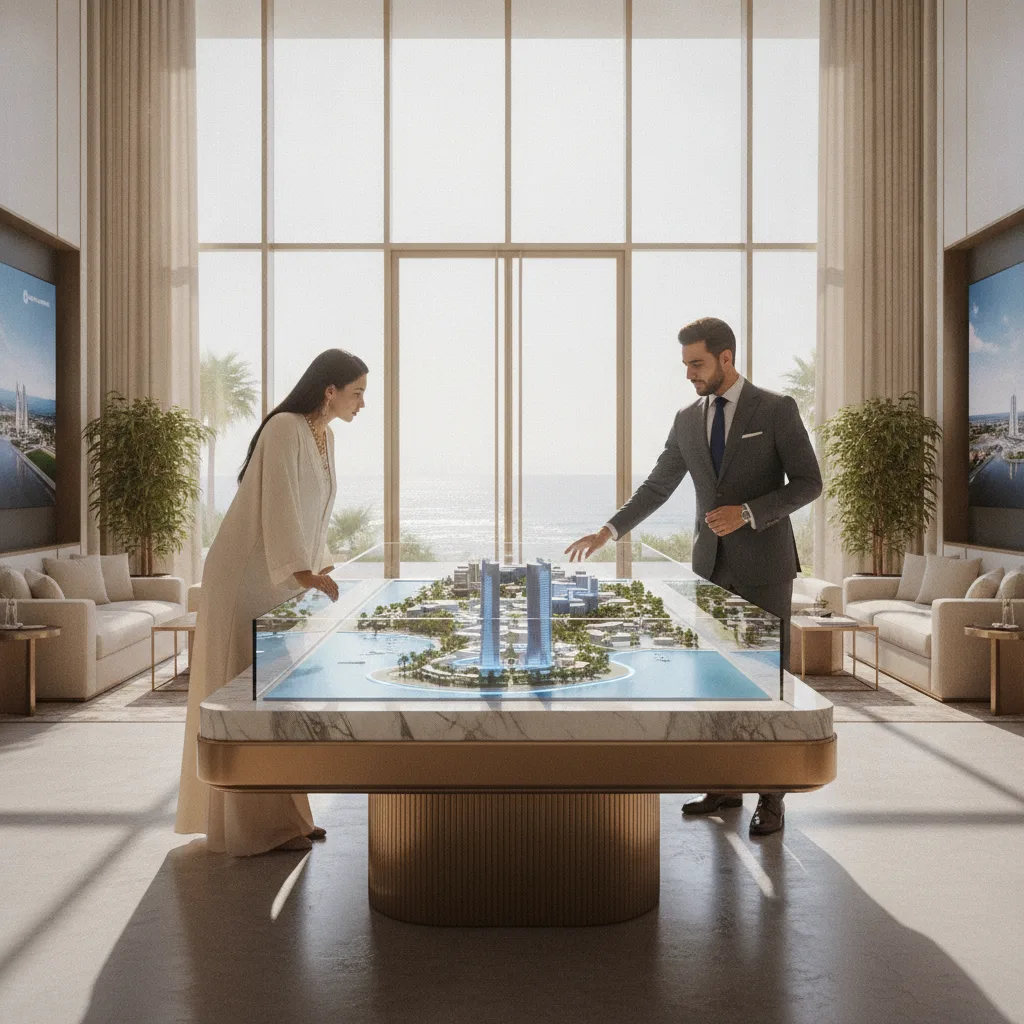
The visual assets launch simultaneously across digital and physical sales channels. Short 15-second vertical video clips drive paid social media campaigns, sending prospects to a project landing page featuring the real-time WebGL unit selector. Inside the physical sales center, interactive touchscreens and VR headsets replace traditional scale models, enabling visitors to compare interior packages, evaluate floor heights, and reserve units instantly.
Executing CGI production, custom web application development, and social media media assets under one roof through Art Sun Studio’s six specialized in-house teams eliminates vendor handoff delays between 3D artists, web developers, and campaign managers. Architectural modifications update across digital flythroughs, floor plan renders, and WebGL applications simultaneously without fragmented contractor back-and-forth.
Budget Benchmarks and Common Execution Mistakes
Managing capital allocation for 3D real estate visualization requires clear price and timeline benchmarks. Establishing visual line-item budgets early allows project directors to balance production spend against expected off-plan pre-sale revenue.
Standard market benchmarks and production timelines for real estate 3D visualization include:
- Static High-Res Hero Renders: $250 to $1,500 (approx. OMR 100 to 580) per view. Production turnaround: 3 to 7 business days. Primary application: Print brochures, site hoardings, digital display ads.
- Isometric 3D Floor Plan Renders: $150 to $600 (approx. OMR 60 to 230) per layout variant. Production turnaround: 2 to 4 business days. Primary application: Website unit pages, digital sales PDF kits.
- Cinematic 3D Flythrough Animations: $2,000 to $10,000+ (approx. OMR 770 to 3,850+) per completed minute. Production timeframe: 3 to 6 weeks. Primary application: Launch events, website hero headers, VIP pitch decks.
- Interactive WebGL Unit Selectors: $5,000 to $20,000+ (approx. OMR 1,900 to 7,700+) per project. Production timeframe: 4 to 8 weeks. Primary application: Sales gallery touchscreens, online real-time booking engines.
Avoiding common execution mistakes protects project budgets and launch deadlines during visual asset creation.
A frequent mistake is starting 3D animation rendering before locking BIM and CAD architectural plans. Introducing layout changes mid-production forces rendering engines to recalculate lighting calculations and complex geometry meshes, causing unexpected change fees and delaying launch dates. Structural floor plans and interior footprints must be frozen before storyboards are approved for rendering.
Another error involves hiring offshore visual studios that lack regional environmental awareness. Foreign foliage, incorrect solar trajectories, or inaccurate interior styling compromise project credibility. Partnering with a studio that operates locally ensures sun angles, native landscaping flora, and regional architectural details align with local market expectations.
Publishing heavy, uncompressed video assets on marketing landing pages also harms lead capture rates. High-bitrate 4K video renders that load slowly on mobile networks increase user bounce rates. Visual files should be encoded into lightweight MP4 formats and responsive WebGL structures optimized specifically for mobile networks across Oman and Iran.
Frequently Asked Questions About Real Estate 3D Animations
What technical files must a developer supply to initiate 3D real estate visualization?
Developers need to supply complete CAD floor plans, building elevations, site master plans, and landscape plans. Providing BIM or REVIT files accelerates digital geometry setup. Detailed interior schedules covering finishes, lighting fixtures, and material samples prevent revision delays during production.
Can interactive WebGL unit selectors integrate with local CRM platforms?
Yes. Custom WebGL interactive unit selectors connect via API to standard CRM systems such as Salesforce, Zoho, or custom developer databases. This integration keeps unit availability updated across web portals and sales center touchscreens in real time, preventing duplicate unit reservations.
How do short social media 3D reels compare to full cinematic flythroughs for lead generation?
Short 15 to 30 second vertical video clips tailored for Instagram and WhatsApp generate top-of-funnel impressions and reduce lead acquisition costs. Full 60 to 90 second cinematic flythroughs function as conversion tools designed to close qualified investors during direct presentations or private pitch meetings.
Why is regional context important when choosing a 3D animation studio?
Offshore visualization vendors often overlook regional specificities such as Middle Eastern sun trajectories, native flora, and localized architectural styling. Working with a studio with regional operations ensures visual assets accurately reflect local solar behavior, native landscaping, target buyer preferences, and local building regulations.
Accelerating Pre-Construction Sales Capital
Deploying 3d animation solutions for real estate turns technical architectural plans into powerful sales assets long before excavation starts on site. High-fidelity visual collateral reduces investor risk, satisfies off-plan legal disclosure mandates in Oman, and builds buyer trust in Iran’s pre-sale market. Real estate developers use photorealistic CGI not as a late marketing add-on, but as a primary driver of pre-construction capital.
Partnering with an experienced creative studio ensures every visual deliverable meets strict technical and aesthetic standards. Founded in 2003 in Isfahan by creative director Ehsan Rezapour, Art Sun Studio is a full-service creative studio in Muscat with operations expanding across the GCC. Operating with six specialized in-house teams across Design, Film, Graphic Design, Social Media, Web Design, and AI, the studio delivers comprehensive visual campaigns across English, Arabic, and Persian channels.
Review your project’s pre-sale collateral with Art Sun Studio’s CGI production team in Muscat or Isfahan to build an interactive 3D rendering pipeline before your project breaks ground.