Securing outdoor aerial permits for commercial architectural video production in Oman takes three to four weeks through Form AWR-033, while indoor FPV drone filming requires no civil aviation permit at all. For commercial property developers, resort operators, and asset managers in Muscat and Isfahan, timing production around regional regulatory approvals and brief 20-to-30-minute sun windows determines whether a shoot stays on schedule. Budgeting typically ranges from OMR 1,200 to OMR 4,500 ($3,100 to $11,700 USD) for a full multi-day commercial shoot, with post-production mastering taking 10 to 18 business days.
A asset manager standing on the dusty concourse of a newly finished commercial center along Sultan Qaboos Street in Muscat cannot afford to have a film crew sitting idle while aerial permits stall. Executing a successful property shoot requires managing two distinct operational environments simultaneously: the regulatory airspace overhead and the physical facility on the ground. Operating without local flight approvals risks immediate security intervention and equipment confiscation, while poor physical staging leads to washed-out limestone facades and severe color casts across interior footage.
Navigating Regulations for Architectural Video Production: Oman’s Serb Platform vs. Iran’s CAOI Portal
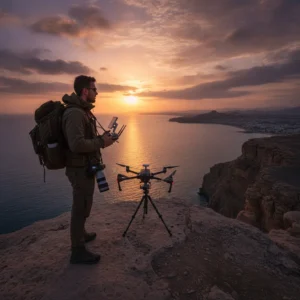
Professional drone aerial videography for commercial real estate requires full compliance with national aviation authorities and security agencies. Flying an unpermitted drone for commercial real estate video production in Muscat or Isfahan exposes asset owners to project halts, administrative fines, and asset seizure.
In Oman, the Civil Aviation Authority (CAA) manages commercial and recreational drone operations through the digital Serb platform. Pilots must hold registered AirPass approval and operate strictly within designated Green Zones. For commercial filming projects, submitting an Oman CAA drone permit Form AWR-033 is mandatory. This application triggers a multi-agency security review involving four separate authorities: the Royal Oman Police (ROP), National Security Agency (NSA), Royal Air Force of Oman (RAFO), and the Ministry of Information.
This clearance process requires a lead time of 3 to 4 weeks before your targeted shoot date. Operating an unauthorized drone or flying over restricted perimeters carries administrative fines between 500 and 600 Omani Rials (OMR), alongside potential legal prosecution. Furthermore, Oman enforces strict security perimeters around government infrastructure, coastal ports, and royal properties, making early pre-production airspace mapping mandatory for Muscat real estate projects.
A single unpermitted flight can halt an entire marketing campaign before it starts.
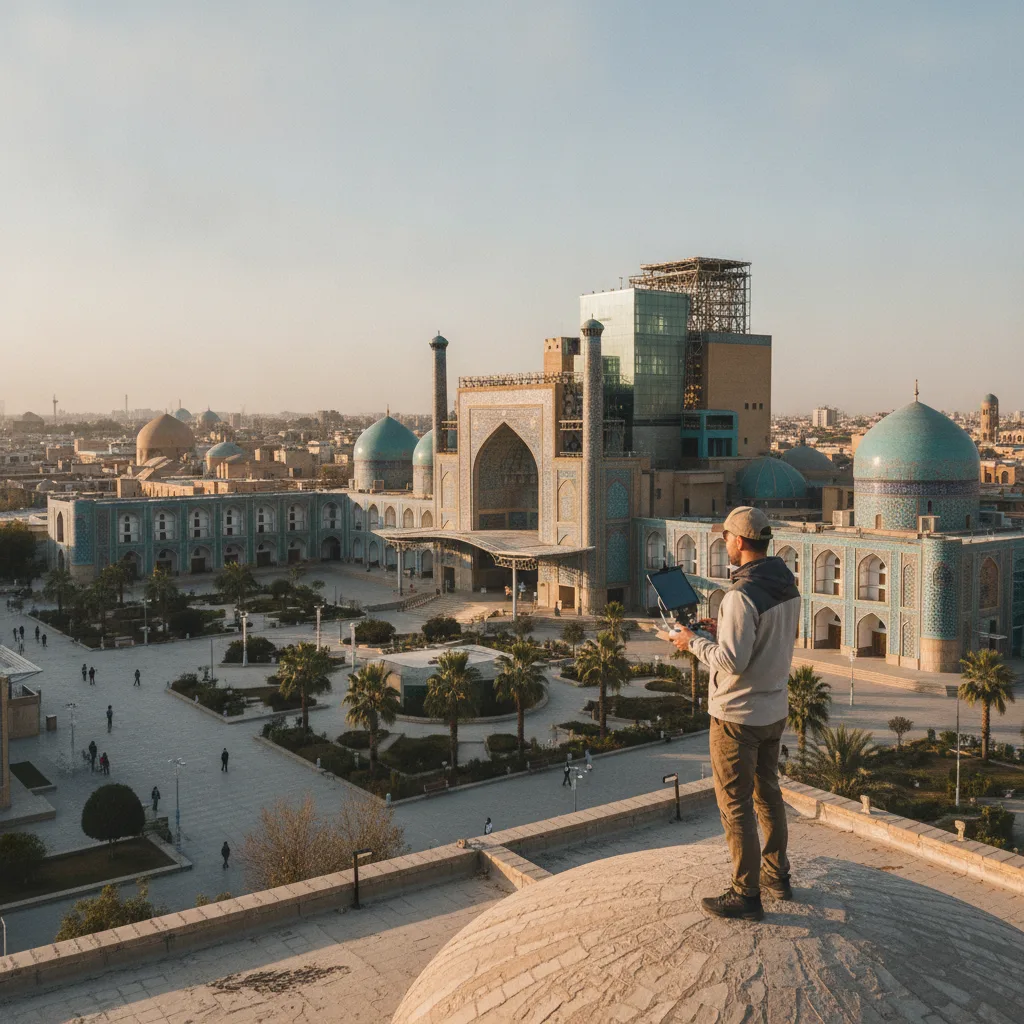
In Iran, the Civil Aviation Organization of Iran (CAOI) governs commercial drone operations under distinct Iran drone filming regulation CAOI rules. All civilian drones used for filming or industrial property video filming in Isfahan must be registered on a central portal to obtain a unique identification number displayed visibly on the airframe. Non-recreational filming requires joint licensing approval from the Ministry of Defense, the IRGC Intelligence Organization, and the CAOI, with every individual flight plan logged in a central tracking system prior to takeoff.
Indoor Drone Filming Exemption: CAA Oman officially clarified that indoor drone operations conducted inside enclosed commercial buildings or private venues are exempt from outdoor airspace licensing requirements. Provided you secure written venue owner approval and implement localized safety protocols, an FPV indoor drone real estate tour offers a legally sound method to capture dynamic spatial flow without waiting weeks for outdoor flight clearances.
Solar Geometry and Microclimates: Exterior Architectural Video Production in Muscat and Isfahan
The microclimates of Muscat and Isfahan present contrasting atmospheric conditions. Direct overhead sunlight between 10:00 AM and 3:00 PM creates intense highlights that clip digital camera sensors, flattening architectural depth and obscuring structural textures.
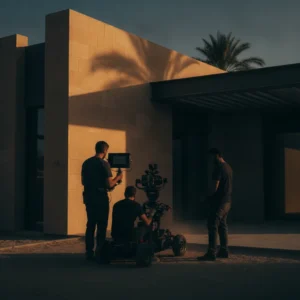
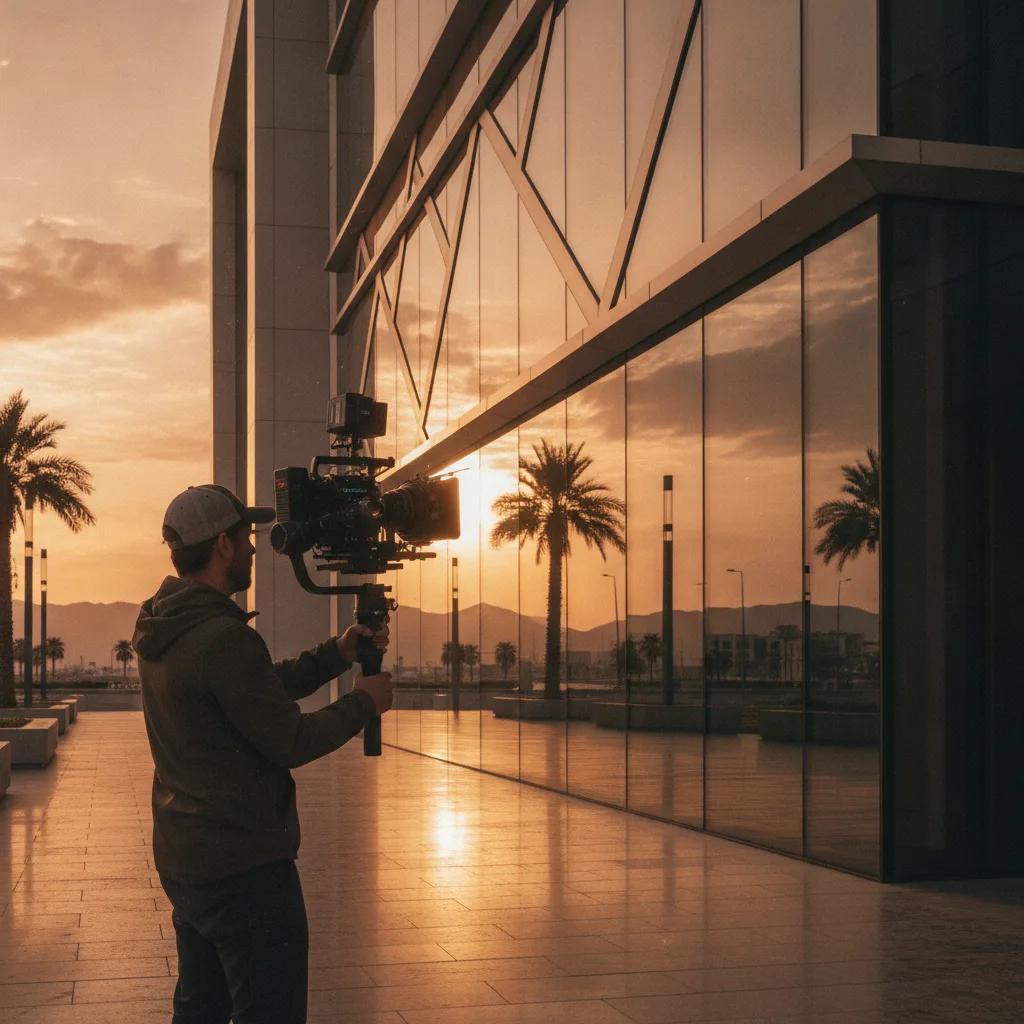
Muscat sits at a low coastal latitude backed by dark granite mountains. Atmospheric conditions feature intense UV glare and harsh reflections off light-colored building surfaces such as Omani white render, polished concrete, and glass curtain walls. Because of this coastal light geometry, golden hour and blue hour twilight windows are unusually short—lasting only 20 to 30 minutes at sunrise and sunset. Exterior camera crews in Muscat must coordinate exact flight paths and ground slider movements to capture key elevation angles before high-contrast daylight flattens the facade.
Isfahan sits on a high-altitude plateau characterized by direct sun exposure and clear sky conditions. Filming the architectural fusion of traditional brickwork, intricate tilework, and modern structural glass requires active shadow management. An experienced luxury brand video production studio utilizes polarizing filters and neutral-density filtration to manage sky saturation and intense daylight glare while complying strictly with municipal guidelines across urban heritage preservation zones.
Live-Action Commercial Cinematography vs. Photorealistic 3D Architectural Renders
Property developers frequently balance live-action architectural walkthrough video production against photorealistic 3D architectural rendering. The ideal choice depends on asset completion status, construction timelines, and target audience needs.
Executing live-action visual production for a finished beachfront resort in Muscat provides authentic visual proof to prospective guests and institutional investors. Flying a micro FPV drone through an open-air resort lobby, gliding over an infinity pool, and moving out toward the coastline establishes genuine spatial flow. Physical camera movements capture true material textures, natural ambient light interaction, and human scale across active commercial spaces.
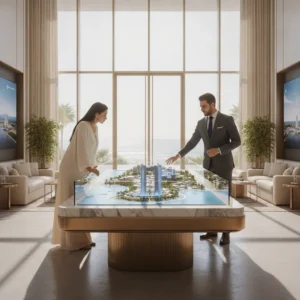
Conversely, when pre-leasing an industrial logistics park or mixed-use commercial development in Isfahan where Phase 1 is complete but Phase 2 remains under construction, a hybrid visual approach is recommended. Live-action ground footage captures the operational Phase 1 buildings, while 3D architectural animation and CGI overlays illustrate the completed vision for Phase 2.
Across regional visual markets, high-end 3D architectural animation and photorealistic CGI walkthroughs average $5,000 to $12,000 USD (approximately 1,920 to 4,600 OMR) per finished minute. Live-action property shoots offer lower cost ratios per minute of finished footage when physical structures are fully constructed, delivering strong marketing return on investment for operational properties.
Commercial Architectural Video Production Costs, Timelines, and Deliverables
Budgeting for commercial architectural videography pricing in Oman requires evaluating four core cost drivers: facility square footage, aerial security permit processing, total filming days, and post-production graphic requirements.
In Oman, full-service architectural video production generally ranges from OMR 1,200 to OMR 4,500 ($3,100 to $11,700 USD). This scope covers multi-day production schedules including cinema-grade ground tracking, licensed interior FPV flights, motion-controlled slider moves, sound design, color grading, and multi-format delivery assets.
Production Phase
Standard Timeframe
Primary Deliverables & Milestones
Pre-Production & Clearances
2 to 4 Weeks
Form AWR-033 clearance routing, Serb platform / CAOI portal registration, indoor flight path mapping, interior staging checklists.
On-Site Filming
2 to 4 Days
Golden hour exterior drone passes, blue hour exterior ground shoots, indoor FPV spatial walkthroughs, interior detail tracking.
Post-Production Mastering
10 to 18 Business Days
Assembly edits, dual-tone color grading, ambient sound design, 3D graphic tracking overlays, multi-ratio final exports.
Contractual deliverables must cover every marketing asset your distribution strategy demands across digital and traditional channels:
- 16:9 4K Master Video: Formatted for corporate web portals, investor presentations, commercial property trade shows, and boardroom displays.
- 9:16 Vertical Cuts: Re-edited and framed specifically for mobile engagement on social platforms like Instagram Reels.
- 30-Second Promo Edits: High-tempo cuts designed for targeted digital advertising campaigns and lead generation formats.
- Commercial Licensing: Full broadcast, digital, and social distribution rights alongside rights-cleared musical compositions.
Site Staging and Operational Checklist for Active Commercial Venues
Filming an operational resort, retail complex, or manufacturing site requires careful physical preparation. Unplanned disruptions occur when facility managers and production crews fail to synchronize site operations prior to call times.
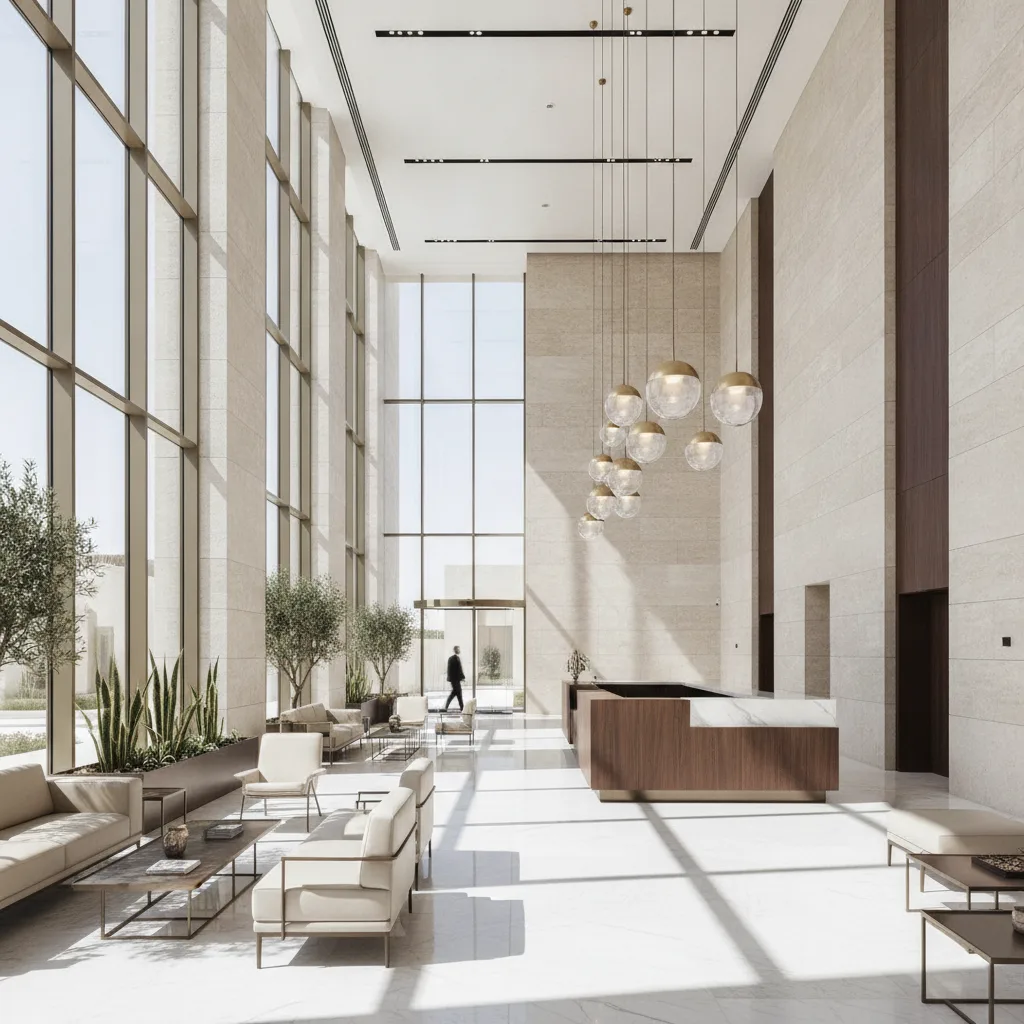
- Conduct an Interior Lighting Audit: Standardize interior lighting fixtures across major concourses. Mixing 3200K tungsten spotlighting with 5600K daylight streaming through atrium glass causes mixed color temperatures that create severe orange and cyan color casts in post-production.
- Clean All Architectural Glass Surfaces: Schedule exterior and interior window washing two days prior to filming. High-resolution 4K camera sensors reveal dust specks, streaks, and handprints on glass facades, balustrades, and entrance doors.
- Control Mechanical HVAC Airflow: Power down high-velocity HVAC diffusers and industrial overhead fans in areas scheduled for indoor FPV drone flights. Internal air turbulence destabilizes ultra-lightweight FPV aircraft, affecting spatial stability.
- Schedule Foot Traffic and Staff Activity: Coordinate dedicated filming windows for main lobbies, dining rooms, or industrial floors. Filming primary hero shots during low-occupancy hours gives the director control over framing and privacy.
- Enforce Regional Privacy Guidelines: Respect local cultural privacy norms. Post visible notice signs informing visitors of active filming, and direct camera angles away from unconsenting individuals, private residential balconies, or adjacent private villas.
Failing to follow these staging procedures risks costly production mistakes. Flying outdoor drones without valid Serb platform drone license Oman approvals or CAOI authorization invites security interventions, fines up to 600 OMR, and equipment confiscation. Filming glass and limestone exteriors under harsh 12:00 PM sunlight results in clipped highlights and flat, featureless facades. Leaving interior color temperatures uncorrected creates heavy color-grading delays, while ignoring privacy boundaries around residential quarters can lead to legal complaints.
Frequently Asked Questions About Commercial Architectural Videography
Do I need a CAA permit to film an indoor FPV drone tour inside a mall or hotel in Muscat?
No. Civil Aviation Authority (CAA) Oman regulations explicitly exempt indoor drone flights inside fully enclosed private structures from outdoor airspace licensing, provided you have written authorization from the property owner and local venue safety measures in place.
How long does it take to secure outdoor aerial permits for commercial real estate video production in Muscat?
Submitting Form AWR-033 requires 3 to 4 weeks for multi-agency security clearances involving the Royal Oman Police, National Security Agency, Royal Air Force of Oman, and Ministry of Information.
What is the difference between architectural 3D rendering walkthroughs and live-action videography?
Live-action videography captures completed physical structures, spatial lighting, and true human interaction, whereas 3D architectural animation produces photorealistic visual renders for unbuilt, off-plan, or under-construction developments.
What video file formats and aspect ratios should be specified in an architectural video contract?
Contracts should mandate a 4K 16:9 master video for web and investor presentations, alongside 9:16 vertical re-edits optimized for mobile platforms such as Instagram Reels and digital ad channels.
Regional Production Coordination Across Oman and Iran
Executing complex property shoots across Muscat, Isfahan, and the wider region requires an integrated production framework that connects regulatory filings, solar calculations, and multi-disciplinary creative teams. Managing aerial permits across different jurisdictions while maintaining consistent visual standards across ground footage, FPV interior flights, and 3D graphics demands close operational alignment from day one.
Founded in 2003 in Isfahan by creative director Ehsan Rezapour—who brings over 25 years of hands-on experience across filmmaking, commercial photography, visual design, and studio leadership—Art Sun Studio expanded international operations to Dubai in 2018 and Muscat in 2020. Operating as a full-service creative studio in Muscat with six specialized in-house teams across Design, Film, Graphic Design, Social Media, Web Design, and AI, Art Sun Studio delivers 19 services under one roof. By keeping architectural videography, photoreal CGI renders, 3D architectural animation, and 360° media internal, production workflows remain unified across every phase.
- Brief: Documenting architectural features, commercial objectives, spatial priorities, and target launch dates.
- Proposal: Structuring fixed operational scopes, agency permit routing schedules, and transparent budgets.
- Concept: Mapping precise solar lighting windows, indoor FPV flight vectors, storyboard paths, and staging needs.
- Production: Executing on-site ground cinematography, twilight exterior passes, and indoor FPV drone flights.
- Review: Refining assembly edits, dual-tone color grading, sound design, and CGI tracking through structured client reviews.
- Delivery: Exporting localized 4K master files, vertical social cuts, and commercial media packages ready for deployment.
Submit your site plans, location coordinates, and target campaign dates to Art Sun Studio in Muscat or Isfahan to establish your regulatory lead times and initiate pre-production site mapping.