
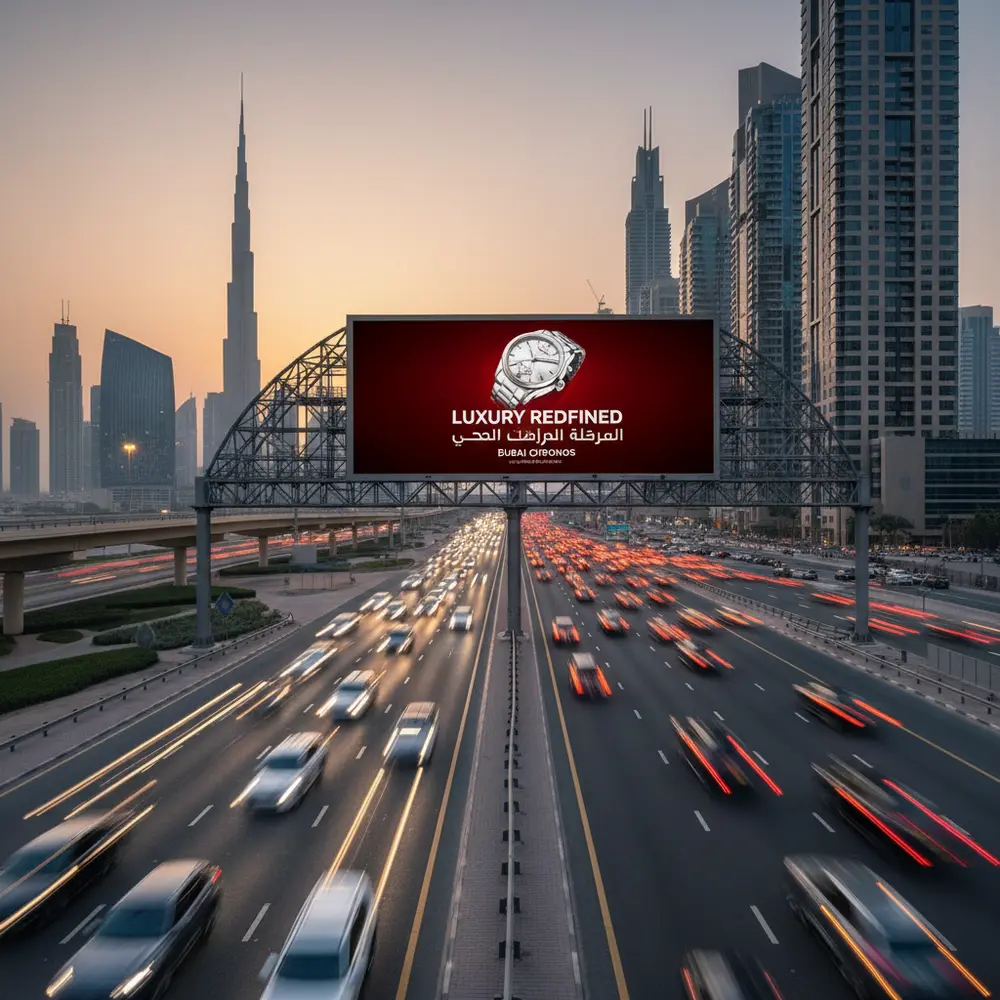
7 Reasons Your Billboard Design on Sheikh Zayed Road is Failing
7 Reasons Your Billboard Design on Sheikh Zayed Road is Failing
Sheikh Zayed Road (SZR) is the lifeline of the United Arab Emirates, a massive artery connecting the towering skyscrapers of Dubai to the industrial hubs and residential sectors. For Dubai businesses, securing a spot on one of the many massive hoardings or digital screens along this highway is a symbol of prestige and a massive investment in visibility. However, simply having a presence on the most famous road in the Middle East does not guarantee success. Hundreds of thousands of cars pass these signs daily, yet many brands find their ROI lacking. If your message is being ignored by the fast-moving commuters, it is time to analyze why your billboard design on Sheikh Zayed Road is failing. In a landscape where the competition for attention is fierce, even small mistakes in visual hierarchy or messaging can render a million-dirham campaign invisible.
The UAE market is unique. It is a melting pot of cultures, languages, and aesthetic preferences. What works in London or New York might fall flat in the Abu Dhabi market or amongst Sharjah brands. Success requires a deep understanding of local consumer behavior and the physical environment of the Gulf. From the blinding desert sun to the high speeds of modern traffic, the variables are many. To stand out, you need more than just a big sign; you need a strategic masterpiece that respects the constraints of out-of-home (OOH) advertising in a high-speed environment.
1. Overcrowding the Visual Space with Too Much Information
The most common mistake seen on SZR is the attempt to treat a billboard like a brochure. Many UAE companies feel the need to include their entire product list, three phone numbers, a physical address, and several social media icons. On a highway where cars are moving at 100 to 120 km/h, the audience has roughly five to seven seconds to process your message. If your billboard design on Sheikh Zayed Road is failing, it is likely because you are asking the viewer to do too much work.
Effective OOH advertising relies on the “six-word rule.” While this is not a hard limit, it serves as a guideline for clarity. Your headline should be punchy and readable at a glance. When you clutter the space with secondary text, you dilute the primary message. The human brain, when traveling at high speeds, prioritizes simple shapes and high-contrast text. By stripping away the fluff and focusing on a single, powerful idea, you ensure that your brand stays top-of-mind. If you are struggling to simplify your message, seeking professional billboard design can help you distill your brand essence into a single, high-impact visual.
2. Poor Color Contrast and Ignoring the Dubai Sun
The environmental conditions in the United Arab Emirates play a significant role in how designs are perceived. The harsh, bright sunlight during the day can wash out pastel colors and low-contrast combinations. Conversely, at night, the neon glow of the city can interfere with poorly lit static boards. If your design uses light gray text on a white background or dark blue on black, it will be unreadable for a significant portion of the day.
High contrast is the secret to visibility on SZR. Think of iconic brands that use bold yellows, deep reds, or stark blacks and whites. These colors cut through the visual “noise” of the desert landscape and the surrounding architecture. Artsun advertising agency emphasizes that color psychology must be paired with environmental physics. A design that looks beautiful on a backlit computer screen in a dark office may look entirely different when printed on a massive vinyl sheet under the 40-degree Celsius Dubai sun. You must test how your colors interact with both natural and artificial light to ensure your message remains vibrant 24/7.
3. Lack of Cultural Relevance and Localization
Dubai is a global city, but it is also the heart of the Arab world. One of the reasons a billboard design on Sheikh Zayed Road is failing is often a lack of cultural nuance. Many international brands make the mistake of using generic stock imagery that does not resonate with the local population. To truly capture the attention of Dubai businesses and residents, your visuals should reflect the lifestyle, values, and diversity of the region.
Language is another critical factor. While English is widely used in business, Arabic is the soul of the UAE. A bilingual approach is often necessary, but it must be executed with balance. If the Arabic typography is treated as an afterthought or if the translation is clunky, it can alienate a massive segment of the Abu Dhabi market and Sharjah brands. Localization is not just about translation; it is about transcreation—adapting the message so it carries the same emotional weight in both languages. Without this connection, your billboard becomes just another piece of background scenery that people ignore on their daily commute.
4. Using Low-Quality or Generic Imagery
On a canvas that can be 20 or 30 meters wide, every pixel counts. Using low-resolution images or generic stock photos is a surefire way to damage your brand’s reputation. When an image is enlarged to billboard size, every imperfection—from compression artifacts to poor lighting—becomes glaringly obvious. If your imagery looks “cheap,” the audience will subconsciously associate that quality with your products or services.
To succeed in the luxury-driven environment of the UAE, you need bespoke, high-end visuals. This is why many successful campaigns invest heavily in advertising photo shooting to create unique assets that cannot be found on a stock website. Whether it is a sleek architectural shot or a high-fashion model, the quality must be world-class. Artsun advertising agency knows that in a city defined by “the biggest” and “the best,” your visual assets must meet that same standard to be taken seriously by the elite consumers of Dubai and Abu Dhabi.
5. An Invisible or Confusing Call to Action (CTA)
What do you want the driver to do after seeing your billboard? This is where many campaigns fall apart. A common reason your billboard design on Sheikh Zayed Road is failing is the absence of a clear, actionable next step. While billboards are primarily a branding tool, they should still guide the consumer toward a conversion path. However, in the UAE, the CTA must be designed for safety and speed.
Expecting a driver to write down a long URL or a mobile number while navigating traffic is unrealistic. Modern digital marketing in UAE has evolved to use more clever CTAs. This might include a very short, memorable vanity URL, a simple search term (e.g., “Search [Brand Name]”), or even a large, recognizable logo that leads them to your web design services in Dubai once they are off the road. The goal of the billboard is to trigger a memory or an intent that the consumer will act upon later. If your CTA is too small, too complex, or missing entirely, you have wasted your most valuable advertising real estate.
6. Poor Typography and Readability Issues
Typography is the silent engine of billboard success. You could have the most beautiful image in the world, but if your font is illegible, the message is lost. Many designers choose “pretty” fonts—thin scripts or overly decorative typefaces—that disappear when viewed from a distance or at an angle. If your billboard design on Sheikh Zayed Road is failing, check your font weight and kerning.
San-serif fonts with thick strokes are generally the best choice for OOH advertising. You also need to consider the “stacking” of your text. Horizontal text is much easier for the human eye to track than vertical or slanted text. Additionally, the spacing between letters (kerning) needs to be wider than usual; at a distance, letters tend to bleed together. Ensuring that your brand name is presented with an impactful logo design that remains legible even in motion is a fundamental requirement for highway advertising. If commuters can’t read who you are, they won’t know who to buy from.
The Importance of Viewing Distance
A billboard that looks great on a 27-inch monitor may be unreadable from 200 meters away. Designers must account for the scale. The headline should be the largest element, followed by the brand mark. Everything else is secondary. In the fast-paced environment of SZR, if you try to make everything big, nothing stands out. You must create a hierarchy that leads the eye naturally from the hook to the brand.
7. Inconsistent Branding and Frequency
A single billboard, no matter how well-designed, rarely changes a consumer’s mind overnight. Marketing is about repetition. However, if your billboard design on Sheikh Zayed Road is failing, it might be because it feels disconnected from the rest of your marketing efforts. Your SZR presence must be an extension of your full-service creative solutions across all platforms.
Consistency in colors, fonts, and tone of voice ensures that when a customer sees your ad on the highway, then sees a post on social media, and finally visits your website, they feel a sense of familiarity. In the competitive landscape of UAE companies, brand recall is everything. If your billboard looks like it belongs to a different company than your Instagram page, you are confusing your audience. Furthermore, placement matters. Strategic repetition across Dubai, Sharjah, and Abu Dhabi helps solidify your position as a market leader. This is a strategy used by a leading agency in the region to ensure that brand messaging is cohesive and omnipresent.
How to Fix a Failing Billboard Strategy
If you realize your current campaign isn’t hitting the mark, don’t panic. The first step is to conduct a “drive-by test.” Have someone who hasn’t seen the design look at it for exactly five seconds and then ask them what the brand was and what the message was. If they can’t answer, your design is too complex. Simplifying the visual, boosting the contrast, and sharpening the CTA can often turn a failing campaign into a success.
Furthermore, consider the transition to digital billboards if your budget allows. Digital OOH (DOOH) on SZR allows for movement and dynamic content, which can be much more effective at catching the eye than static images. However, the same rules of simplicity and legibility apply. Whether static or digital, the core of your strategy should be focused on the user’s experience behind the wheel. By prioritizing the driver’s perspective, you can transform your billboard from a blur on the horizon into a landmark of your brand’s success.
Frequently Asked Questions
How much text should be on a billboard on Sheikh Zayed Road?
Ideally, you should aim for six to seven words or fewer. Since drivers are moving at high speeds, they only have a few seconds to digest your message. Focus on one strong headline and a clear brand logo.
Should I use English or Arabic for my UAE billboard?
In most cases, a bilingual approach is best for Dubai and Abu Dhabi. This ensures you reach both the local Emirati population and the large expatriate community. However, the design must be balanced so that neither language feels crowded or secondary.
What is the “6-second rule” in billboard design?
The 6-second rule states that a billboard should be able to communicate its entire message within six seconds. This is the average time a driver has to look at an ad while maintaining focus on the road. If it takes longer than that to understand, the design is too complex.
Can I use QR codes on highway billboards?
Generally, no. Using QR codes on high-speed highways like SZR is a safety hazard and is physically impossible for a driver to scan. QR codes are better suited for “pedestrian” OOH, such as at bus stops, in malls, or at metro stations.
How often should I change my billboard design?
To avoid “ad fatigue,” it is recommended to refresh your creative every 3 to 6 months. While your core branding should remain consistent, updating the imagery or the specific offer keeps the audience engaged and prevents them from tuning out your ad as part of the background scenery.
Conclusion
Mastering the art of billboard advertising in the UAE requires a blend of creative brilliance and practical logic. If your billboard design on Sheikh Zayed Road is failing, it is likely due to a lack of focus, poor technical execution, or a failure to adapt to the local environment. By simplifying your message, prioritizing high-contrast visuals, and ensuring cultural relevance, you can capture the attention of millions of potential customers. In a region as dynamic as the Middle East, staying relevant means being bold, clear, and consistent.
If you are ready to elevate your brand’s presence and ensure your investment delivers results, it is time to partner with experts who understand the nuances of the local market. Whether you are targeting Dubai businesses or looking to expand among Sharjah brands, a well-executed OOH strategy is your ticket to growth. Contact Artsun advertising agency today to transform your vision into a high-impact reality that commands attention on the most famous road in the world.

