The Power of Negative Space in UAE Logo Design: Mastering Minimalism for Local Brands
In the rapidly evolving visual landscape of the Middle East, the art of logo design has transcended mere decoration to become a sophisticated language of identity. For Dubai businesses and established enterprises across the United Arab Emirates, the challenge is no longer just about being seen, but about being remembered. One of the most potent tools in a designer’s arsenal to achieve this memorability is the clever use of negative space. Often referred to as “white space,” negative space is the area surrounding and between the subjects of an image. In the context of logo design, it is the art of using nothing to say everything. As the Abu Dhabi market becomes more saturated with global and local competitors, the ability to communicate a dual message through a single, clean mark has become a hallmark of premium branding.
Negative space in UAE logo design is not merely a stylistic choice; it is a strategic necessity. When a brand utilizes the space around its primary icon to reveal a hidden symbol or secondary meaning, it creates a “Eureka!” moment for the viewer. This psychological engagement fosters a deeper connection between the brand and the consumer. In a region where luxury, precision, and innovation are highly valued, minimalist designs that utilize negative space reflect a brand’s confidence and clarity of vision. Whether it is a subtle curve that forms a falcon or a gap in typography that represents the iconic Dubai skyline, these designs resonate deeply within the local cultural context while maintaining a world-class aesthetic.
Understanding Negative Space in the Context of UAE Branding
To appreciate the impact of negative space, one must first understand that design is as much about what you leave out as what you put in. In the UAE, where traditional motifs often meet futuristic architecture, the balance between complexity and simplicity is delicate. Effective strategic brand development requires a deep understanding of how the human eye perceives shapes. The brain is hardwired to close gaps and find patterns, a principle known in psychology as Gestalt theory. When a designer leaves an intentional “hole” in a logo, the viewer’s mind subconsciously fills it, making the interaction with the brand more active than passive.
For UAE companies, this technique offers a way to blend heritage with modernity. Many Sharjah brands, for instance, utilize negative space to incorporate traditional Islamic patterns or Arabic calligraphy into sleek, modern shapes. This allows them to appeal to a younger, tech-savvy demographic without losing their cultural soul. The use of negative space also ensures that a logo remains functional. In the intense sun and high-contrast environments of the Emirates, a cluttered logo can become illegible from a distance. A logo designed with ample white space remains crisp and recognizable, whether it is on a business card in a DIFC office or a massive digital screen at the Dubai Mall.
Why Negative Space Works for Dubai Businesses and Sharjah Brands
Dubai is a city of superlatives, and its business environment is equally intense. To stand out, many organizations are moving away from literal, heavy imagery toward more intellectual design solutions. Negative space allows a brand to tell a story without cluttering the visual field. This is particularly important for digital marketing in UAE, where attention spans are short, and the majority of brand interactions happen on small mobile screens. A clean logo with a clever use of negative space scales perfectly, maintaining its integrity even when reduced to a tiny favicon or an app icon.
In the Sharjah market, which is often seen as the cultural and educational hub of the Emirates, branding tends to be more thoughtful and nuanced. Here, negative space is used to evoke emotions and represent values like growth, stability, and community. By using bespoke logo design techniques, local firms can create identities that reflect their unique place in the market. For example, a logistics company might use the space between letters to create an arrow, symbolizing movement and efficiency, while a real estate developer might use negative space to form the silhouette of a home within a corporate monogram.
The Artsun advertising agency understands that the UAE consumer is highly sophisticated. They are exposed to the best global brands daily. Therefore, a logo must do more than just identify; it must intrigue. By utilizing negative space, a brand positions itself as a leader that values intelligence and creativity. This approach is highly effective for B2B firms in the UAE, where a professional and “smart” image can be the deciding factor in securing large-scale contracts and partnerships.
The Psychological Impact of Minimalism
Minimalism is often associated with luxury and exclusivity. In the UAE, where the luxury sector is a major economic driver, adopting a “less is more” philosophy in logo design can significantly elevate a brand’s perceived value. Negative space is the ultimate expression of this philosophy. It suggests that the brand does not need to shout to be heard. This quiet confidence is highly attractive to high-net-worth individuals in the Abu Dhabi market and Dubai’s elite social circles.
Enhancing Brand Recall Through Visual Puns
A visual pun—where one shape holds two meanings—is the most common application of negative space. These “hidden” messages act as a reward for the viewer. When a customer finally “sees” the hidden image, they feel a sense of satisfaction. This positive reinforcement makes the brand much more likely to be remembered later. For UAE companies looking to build long-term loyalty, this initial spark of engagement is invaluable.
Cultural Nuances and Symbolism in Abu Dhabi Logo Design
Abu Dhabi, as the capital, often leans toward branding that reflects authority, legacy, and national pride. When designing logos for the Abu Dhabi market, it is essential to consider how negative space can be used to honor local symbols. The falcon, the dhow, the date palm, and the desert dunes are all powerful icons that can be subtly integrated into a design using the surrounding space. This subtle integration often feels more sophisticated than a direct illustration.
Furthermore, the interplay between English and Arabic typography offers a unique playground for negative space. Many successful UAE logos are bilingual, and the space between the two scripts can be used to create a unified symbol that bridges different cultures. This is a core component of successful Artsun Studio projects, where the goal is to create a visual harmony that speaks to the diverse, multicultural population of the Emirates. By treating the letters of both languages as geometric shapes, designers can find overlapping areas that form a new, secondary icon, representing the fusion of tradition and global ambition.
Practical Applications: From Billboard Design to Digital Platforms
The effectiveness of a logo is tested by its versatility. In the UAE, a brand must look as good on a luxury yacht in Dubai Marina as it does on a LinkedIn profile. Negative space ensures this versatility by providing a “breathing room” that prevents the logo from getting lost in busy environments. When we look at outdoor advertising visuals along Sheikh Zayed Road, the most impactful designs are almost always the ones that utilize negative space to draw the eye toward the center of the message.
In the digital realm, the simplicity of negative space logos is a major advantage. High-resolution displays in the UAE, from smartphones to giant 8K public screens, demand designs that are sharp and well-defined. A logo with too many fine details or overlapping elements can become “muddy” on screen. By focusing on the relationship between the positive and negative shapes, designers create marks that are robust and “future-proofed” against evolving display technologies.
Consistency Across Physical Touchpoints
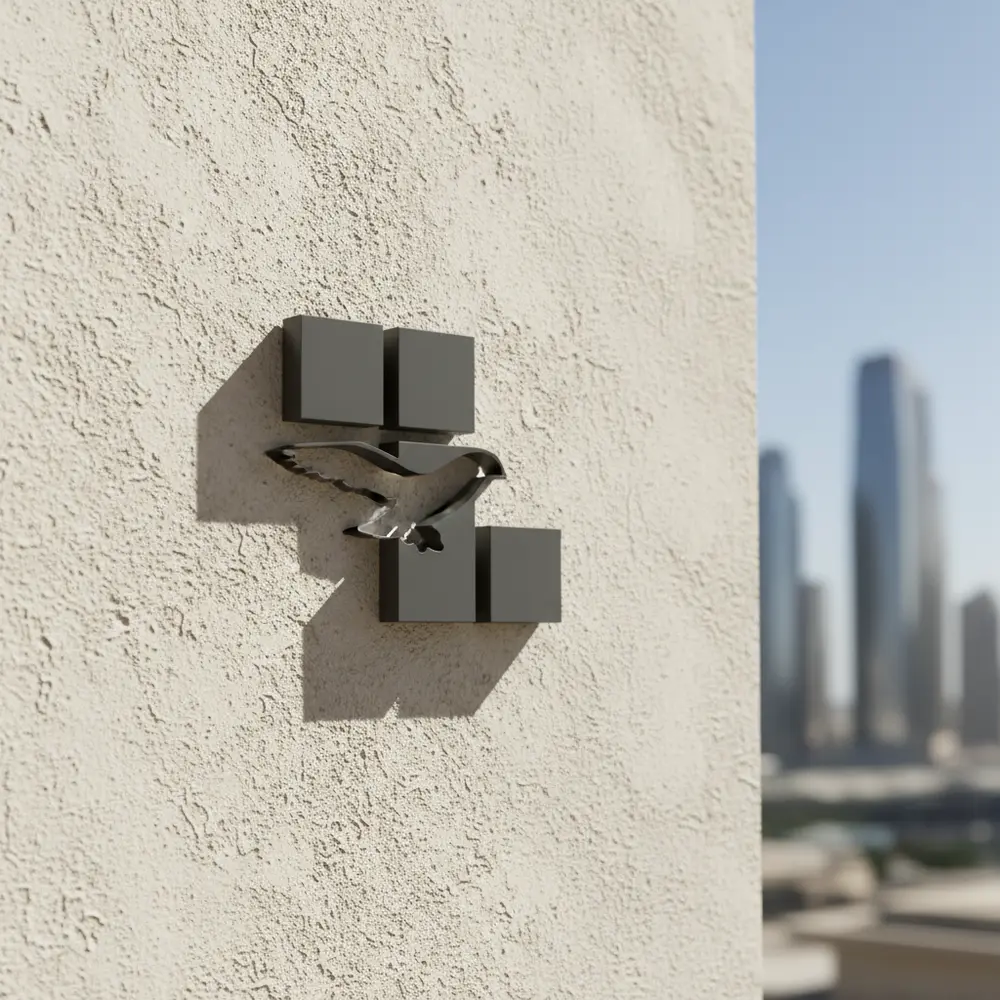
Beyond billboards, the use of negative space is crucial for corporate stationery, uniforms, and physical signage. For a Dubai business, the logo might appear embossed on high-end leather, etched into glass, or 3D-printed for an office lobby. The clarity provided by negative space makes these physical applications much easier to execute and more visually striking. It allows for play with shadows and light, adding a tactile dimension to the brand identity.
Optimizing for Social Media and Mobile App Icons
As the primary channel for customer engagement, social media requires logos that are instantly recognizable in a circular or square format. Negative space allows the core essence of a brand to be distilled into a compact area without losing its meaning. This is a critical aspect of any digital content management strategy in the UAE, where visual storytelling is the key to capturing the attention of a fast-moving audience.
The Role of Professional Design Agencies in the UAE
Creating a truly effective negative space logo is one of the most difficult tasks in graphic design. It requires a high level of technical skill, a deep understanding of optical illusions, and a keen eye for balance. This is why many leading UAE companies partner with a specialized Artsun advertising agency to refine their visual identity. A professional agency does not just look for a “cool” design; they conduct extensive market research to ensure the logo resonates with the target audience in Dubai, Abu Dhabi, and Sharjah.
The process usually involves dozens of iterations. Designers must experiment with different weights, angles, and spacing to ensure the hidden image is neither too obvious nor too obscure. If it’s too obvious, the “magic” is lost. If it’s too obscure, the viewer simply sees a broken or confusing shape. Achieving that perfect balance is what separates a world-class logo from a mediocre one. For businesses investing in high-performance website development, having a professionally crafted logo is the foundation upon which the entire digital experience is built.
Future Trends in Minimalism for UAE Companies
As we look toward the future, the trend of negative space and minimalism in the UAE shows no signs of slowing down. We are seeing a move toward “responsive logos” that change their level of detail based on where they are being viewed. In these cases, the negative space version of a logo is often the “core” version, used for the most simplified applications. Additionally, as motion graphics become more prevalent, we are seeing logos where the negative space “animates” to reveal the hidden message, adding a layer of storytelling that was previously impossible.
The rise of sustainability as a core value for UAE companies is also influencing design. Minimalist logos that use less ink in printing and require less power to render on screens are being seen as a subtle nod to environmental responsibility. This alignment of design aesthetics with corporate social responsibility is becoming increasingly important for brands looking to build trust with the modern Emirati consumer. Negative space, by its very nature, is a sustainable design choice—achieving the maximum impact with the minimum amount of “material.”
Frequently Asked Questions about UAE Logo Design
What is negative space in logo design?
Negative space, also known as white space, is the area around and between the subjects of an image. In logo design, it refers to the practice of using those empty areas to create secondary shapes or symbols, effectively giving the logo a dual meaning.
Why is negative space popular among Dubai businesses?
It is popular because it creates a clean, modern, and sophisticated image. In the competitive Dubai market, a negative space logo helps a brand stand out by offering a clever visual puzzle that increases brand recall and reflects a high level of professional creativity.
Can negative space be used with Arabic calligraphy?
Yes, and it is a growing trend in the UAE. Designers often use the fluid strokes of Arabic script to form the boundaries of a negative space image, creating a beautiful blend of traditional culture and modern design principles.
How does negative space improve a logo’s functionality?
Negative space improves legibility and scalability. By avoiding cluttered details, the logo remains clear and recognizable across various mediums, from small mobile screens to large-scale billboards in Sharjah or Abu Dhabi.
Conclusion: Elevating Your Brand with Strategic Design
In the dynamic and competitive landscape of the United Arab Emirates, your logo is the face of your business. Embracing the power of negative space is more than just following a design trend; it is about adopting a mindset of clarity, intelligence, and cultural relevance. Whether you are a startup in a Dubai incubator or an established Sharjah brand looking to refresh your image, the clever use of white space can transform a simple icon into a powerful storytelling tool. By focusing on minimalism and meaningful shapes, UAE companies can create lasting impressions that transcend language and borders.
If you are ready to redefine your visual identity and capture the essence of your brand through world-class design, the Artsun advertising agency is here to help. Our team of experts specializes in creating bespoke solutions that resonate with the unique nuances of the UAE market. From initial concept to digital execution, we ensure your brand stands out for all the right reasons. Contact us today to begin your journey toward a more impactful and memorable brand presence.