
How to Master Best Video Production Trends in 2026
How to Master Best Video Production Trends in 2026
The digital landscape is shifting at an unprecedented pace, and as we look toward the future, staying ahead of the curve is no longer optional for brands in the Middle East. To truly understand how to master best video production trends in 2026, one must look at the intersection of high-end technology and localized storytelling. In the United Arab Emirates, where innovation is a core pillar of the national vision, video content has evolved from a simple marketing tool into a complex ecosystem of immersive experiences. Digital marketing in UAE has become increasingly competitive, requiring businesses to adopt sophisticated visual strategies to capture the attention of a highly discerning audience. From the bustling streets of Dubai to the cultural hubs of Sharjah, the way we consume media is undergoing a radical transformation driven by artificial intelligence, extended reality, and a renewed focus on authentic human connection.
As we approach 2026, the demand for high-quality visual content is skyrocketing. UAE companies are no longer satisfied with generic stock footage or low-budget productions. Instead, they are investing in bespoke narratives that reflect their brand values and resonate with the diverse demographics of the region. Mastery of these trends requires more than just owning the latest camera equipment; it requires a strategic understanding of how technical innovations can be leveraged to drive engagement and conversion. Whether it is through hyper-personalized video ads or large-scale virtual productions, the goal remains the same: to create a lasting impact in a world where attention is the most valuable currency.
The Evolution of Visual Storytelling for Dubai Businesses
Dubai has always been a city of the future, and its approach to video marketing is no different. By 2026, the evolution of visual storytelling will be defined by a shift from passive viewing to active participation. Dubai businesses are increasingly utilizing interactive video elements that allow viewers to choose their own narrative paths. This level of engagement is particularly effective in the real estate and tourism sectors, where prospective buyers and visitors want to explore spaces virtually before making a commitment. The integration of 360-degree environments and clickable hotspots within videos is becoming a standard expectation rather than a luxury.
Furthermore, the cultural nuances of the Dubai market necessitate a specialized approach to content creation. Successful campaigns in 2026 will be those that master the balance between global aesthetic standards and local cultural sensitivities. This means producing content that is not only visually stunning but also linguistically and culturally relevant to both the expatriate community and the local Emirati population. By focusing on “snackable” yet high-value content, brands can maintain a consistent presence on social platforms while building a reputation for quality and reliability. To achieve this, many organizations are turning to creative marketing solutions in the UAE to ensure their messaging aligns with the rapid pace of the city’s development.
Immersive Experiences: The Rise of CGI and AR in 2026
One of the most significant shifts we are witnessing is the democratization of high-end visual effects. By 2026, the use of Computer-Generated Imagery (CGI) and Augmented Reality (AR) will be commonplace in everyday advertising. Artsun advertising agency has observed that brands are moving away from traditional filming constraints and toward the limitless possibilities of virtual environments. This is particularly relevant for product launches where physical prototypes may not yet be available or where the environment needs to be entirely fantastical to align with a brand’s futuristic identity.
The mastery of CGI and VFX video production allows for the creation of “Hyper-Real” content that blurs the line between reality and simulation. In 2026, we expect to see AR filters that go beyond simple face-tracking, evolving into full-scale world-tracking experiences. Imagine a customer in Abu Dhabi pointing their phone at a billboard and seeing a 3D model of a new car drive out of the frame and into their personal space. This level of immersion creates an emotional bond with the consumer that traditional video simply cannot match. Mastering these trends requires a deep technical knowledge of rendering engines and real-time processing, ensuring that the final output is seamless and believable.
The Impact of Virtual Production Sets
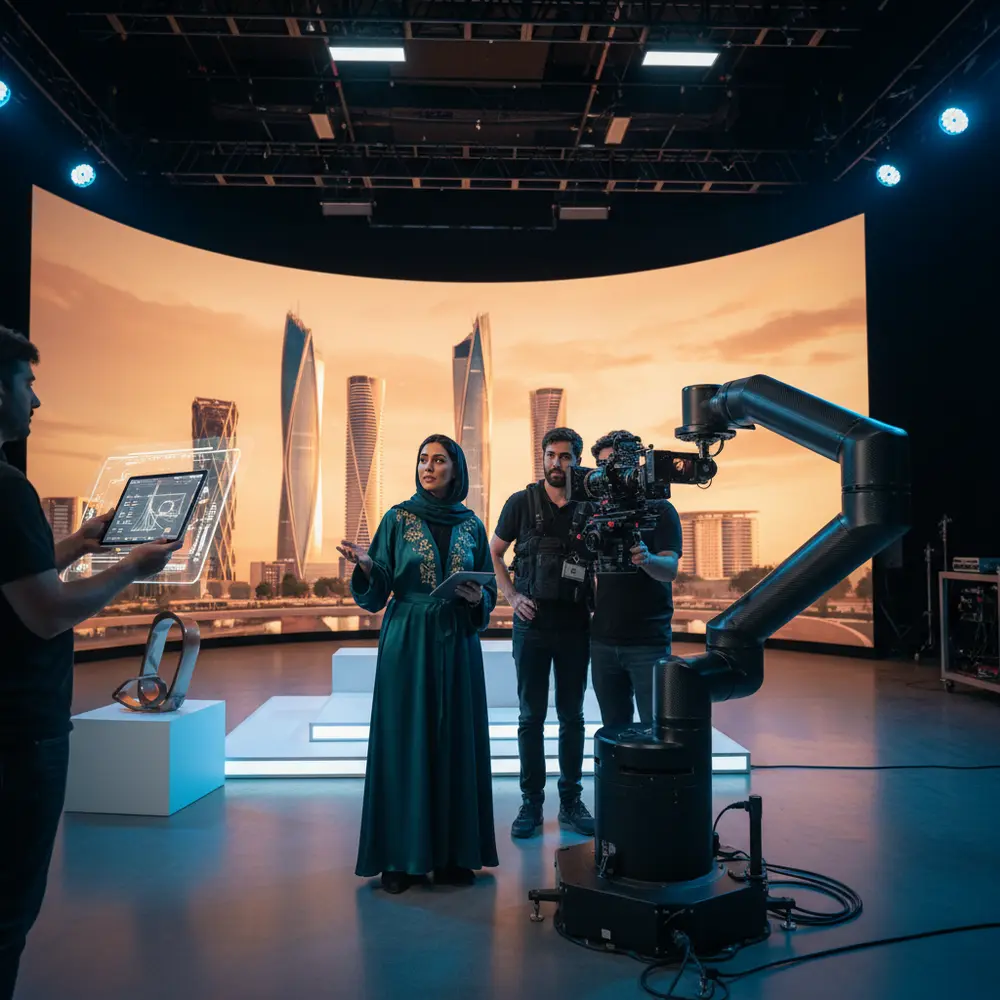
Virtual production, popularized by major film franchises, is now making its way into the commercial sector. By using large LED volumes to display real-time environments, production teams can film subjects in any location without leaving the studio. This tech-heavy approach reduces travel costs and provides total control over lighting and weather conditions, which is a major advantage for UAE companies looking to film during the intense summer months. This trend is not just about convenience; it is about the ability to create visually consistent worlds that reflect the premium nature of the brands involved.
Hyper-Personalization and AI-Driven Video Content
Artificial Intelligence is no longer a buzzword; it is the backbone of modern video production. In 2026, mastering video production means mastering AI-driven workflows. From automated editing to AI-generated voiceovers that sound indistinguishable from humans, the speed of production has increased tenfold. However, the real power of AI lies in personalization. By 2026, we will see the rise of dynamic video content that changes in real-time based on the viewer’s data. A viewer in Sharjah might see a different version of an ad than someone in Abu Dhabi, with localized landmarks and specific product recommendations tailored to their browsing history.
For brands, this means moving away from a “one-size-fits-all” video and toward a modular content strategy. By producing high-quality video production that is designed to be broken down and reconstructed by AI algorithms, businesses can deliver thousands of unique versions of a single campaign. This level of relevance significantly boosts ROI and ensures that the marketing budget is spent on content that actually converts. Artsun advertising agency emphasizes that while AI handles the heavy lifting of data and assembly, the human element—strategy, emotion, and creativity—remains the most critical component of a successful video campaign.
AI and Ethical Considerations in the UAE
As AI becomes more integrated into video, ethical considerations regarding “deepfakes” and data privacy will take center stage. UAE regulators are already looking at frameworks to ensure that AI-generated content is transparent and used responsibly. Mastering this trend involves not only the technical implementation but also a commitment to ethical standards that protect the brand’s integrity and the consumer’s trust. Brands that are transparent about their use of AI will likely see higher levels of loyalty in the long run.
Short-Form Video Mastery for Sharjah Brands
While long-form content still has its place for brand storytelling, short-form video remains the king of engagement. For Sharjah brands looking to tap into a younger, tech-savvy audience, mastering the art of the 15-second hook is essential. By 2026, the algorithms of platforms like TikTok, Instagram Reels, and YouTube Shorts will be even more sophisticated, favoring content that provides immediate value or entertainment. The “raw and authentic” aesthetic that started years ago has evolved into a “lo-fi but high-concept” style where the production quality is high, but the delivery feels personal and unscripted.
Sharjah’s unique position as a cultural and educational capital provides a wealth of storytelling opportunities. Brands can leverage this by creating educational “how-to” videos, behind-the-scenes glimpses into local craftsmanship, or community-focused stories. To succeed, businesses must integrate social media management services into their video production workflow. This ensures that every piece of content is optimized for the specific platform it lives on, from the aspect ratio to the use of trending audio and keywords that improve discoverability within the UAE market.
The Rule of Three: Hook, Value, CTA
In 2026, the structure of short-form video will be more rigid than ever. You have exactly 1.5 seconds to hook the viewer, 10 seconds to deliver the core value, and 3.5 seconds to provide a clear call to action. Mastering this trend requires a “mobile-first” mindset where every frame is designed to be viewed on a vertical screen. Lighting, framing, and text overlays must all be optimized for small displays, ensuring that the message is clear even if the sound is turned off.
The Shift Toward High-End Cinematic Production in Abu Dhabi
The Abu Dhabi market is synonymous with luxury and prestige. For companies operating in the capital, video production in 2026 is about achieving a “Cinematic Standard.” This goes beyond 4K resolution; it’s about the color science, the depth of field, and the sound design that makes a commercial feel like a piece of cinema. As Abu Dhabi continues to position itself as a global media hub, the expectation for world-class production values has never been higher. This is particularly true for the architectural and real estate sectors, where the scale of development requires equally grand visual representation.
Utilizing 3d architectural animation has become a prerequisite for luxury developments in the capital. These animations allow developers to showcase the lifestyle and grandeur of a project long before the first stone is laid. Mastering this trend involves integrating drone cinematography with 3D overlays to create a composite view of the future. The result is a powerful sales tool that appeals to high-net-worth individuals and international investors who expect nothing less than perfection from Abu Dhabi-based brands.
Technical Innovations: 8K, Virtual Production, and Beyond
How to master best video production trends in 2026 also involves staying at the forefront of hardware evolution. While 4K is the current standard, 8K production is becoming the norm for high-end archival and large-scale display purposes. This increased resolution provides incredible flexibility in post-production, allowing editors to crop and zoom without losing detail. Furthermore, the integration of 5G—and the beginnings of 6G—technology in the UAE means that high-bitrate video can be streamed flawlessly, enabling more complex interactive and live-streamed content than ever before.
Virtual production continues to evolve, with smaller, more affordable LED setups allowing even medium-sized UAE companies to utilize “The Volume” technology. This allows for total control over the “Golden Hour” lighting, which is notoriously difficult to capture in the natural world. By mastering these technical tools, production houses can offer more creative freedom to their clients. Those who invest in professional advertising services will find that the technical barriers to entry are disappearing, replaced by a need for higher-level creative strategy and technical execution.
Sustainable Video Production Practices for UAE Companies
As global awareness of environmental issues grows, sustainability is becoming a key trend in video production. For Sharjah brands and Dubai corporations alike, “Green Production” is no longer just a checkbox for corporate social responsibility; it is a demand from the modern consumer. In 2026, mastering video production includes implementing eco-friendly practices on set. This includes reducing plastic waste, using energy-efficient LED lighting, and utilizing remote collaboration tools to minimize the carbon footprint associated with travel.
Remote directing and cloud-based editing suites allow teams across the UAE to collaborate in real-time without the need for physical proximity. This not only makes the production process more sustainable but also more efficient. Companies that adopt these practices often find that they are more agile and able to respond to market changes faster. Artsun advertising agency is committed to these forward-thinking methodologies, ensuring that high-impact visual content does not come at the expense of the environment. By choosing professional advertising services that prioritize sustainability, brands can enhance their reputation among the environmentally conscious demographic of the UAE.
The Future of Remote Collaboration
The rise of the “Metaverse” and spatial computing has further enabled remote production. In 2026, a director in Dubai can walk through a virtual set with a client in London using VR headsets, making real-time adjustments to the environment before a single frame is shot. This level of collaboration is revolutionizing the industry, making the production process more transparent and inclusive. Mastering these remote tools is essential for any agency looking to compete on a global scale while maintaining a strong local presence in the Abu Dhabi market.
Frequently Asked Questions
What is the most important video trend for UAE businesses in 2026?
The most critical trend is hyper-personalization through AI. As the UAE market is diverse, using AI to tailor video content to specific cultural and linguistic groups allows brands to achieve much higher engagement rates and better ROI compared to generic campaigns.
How can a brand in Dubai start using CGI and VFX?
Brands should start by identifying key products or concepts that are difficult to film in real life. By partnering with a specialized agency that understands the local market, they can create “Hyper-Real” 3D assets that can be used across social media, TV commercials, and even AR applications.
Is 8K resolution necessary for marketing videos in 2026?
While most consumers will view content on 4K or mobile screens, filming in 8K is highly beneficial for future-proofing your content and providing more flexibility during the editing process. It is especially recommended for high-end brands in the Abu Dhabi market who want to maintain a premium image.
How does short-form video differ between Dubai and Sharjah?
While both regions value high engagement, Dubai content often focuses on fast-paced, high-luxury lifestyles and global trends. In contrast, Sharjah brands often find success with content that highlights heritage, education, and community values, requiring a more nuanced and culturally grounded approach to storytelling.
Conclusion
Mastering the best video production trends in 2026 requires a multifaceted approach that combines technical excellence with strategic local insight. From the integration of AI and CGI to the adoption of sustainable production practices, the future of video is immersive, personalized, and highly efficient. For UAE companies to thrive in this new era, they must embrace these changes and move away from traditional, static marketing methods. By focusing on authentic storytelling and leveraging the latest innovations, brands can create powerful visual narratives that resonate across the Abu Dhabi market, Dubai’s commercial landscape, and Sharjah’s cultural sectors. The journey to mastering these trends is an ongoing process of adaptation and creativity. If you are ready to elevate your brand’s visual identity and lead the market, now is the time to invest in the future of video. Contact a professional partner today to begin your transformation and capture the attention of the UAE like never before.

