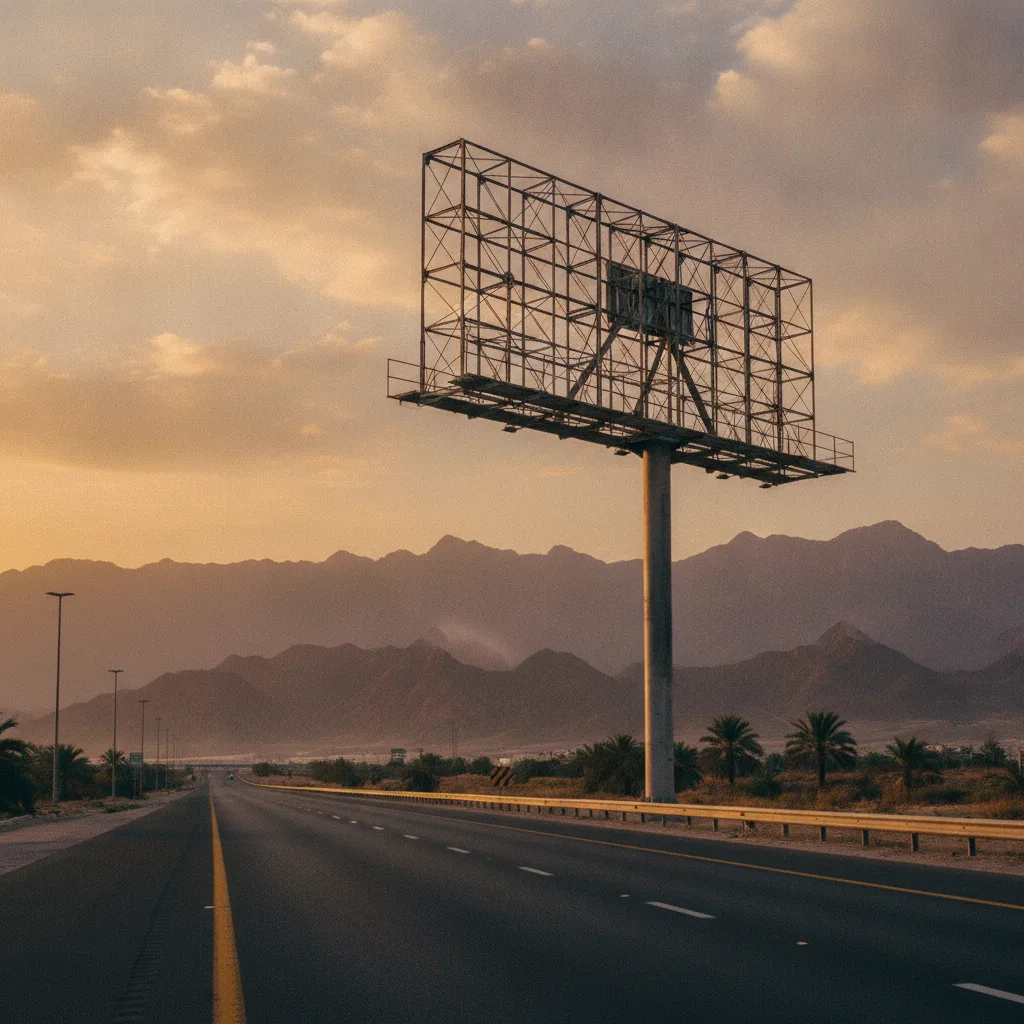
High-impact billboard design requires an immediate visual punch using three to five headline words, high visual contrast against intense solar glare, and full compliance with regional language regulations. Commuters traveling at 90 km/h along arterial corridors like Sultan Qaboos Highway in Muscat or the Ring Expressways in Isfahan have roughly three seconds to process a roadside display. To maximize return on investment, outdoor advertising must balance rapid visual legibility with early municipal permit approvals before committing major capital to site rentals.
A vehicle moving at 90 km/h covers 25 meters every second. When design teams treat large-format hoardings like print catalog pages—cramming bulleted lists, multiple phone numbers, and full web links onto the canvas—the campaign fails to communicate before the driver moves past. Understanding how the human eye processes graphics under harsh midday light determines whether an outdoor display builds brand recall or wastes ad spend.
The 3-Second Rule: Visual Hierarchy and Layout Principles for Billboard Design
According to data from the Out of Home Advertising Association of America (OAAA), viewers look at an outdoor ad for an average of 3 to 7 seconds. On high-speed expressways, that viewing window stays firmly on the shorter end. High approach speeds require disciplined visual reduction.
To ensure drivers retain your core message within a 3-second glance, every layout must follow strict structural rules:
- Headline Brevity: Limit main copy to 3 to 5 high-impact words. Strip away descriptive filler, secondary slogans, and multi-line body paragraphs.
- Solar Contrast: Midday desert sunlight washes out muted pastels and medium gray copy. Select high-contrast pairings such as stark white or bright yellow text on deep navy or charcoal, or dark copy set against a bright neutral background.
- Single Focal Point: Position one visual hero element, such as a sharp product shot, next to a clear brand logo. Multiple competing images scatter the viewer’s focus.
- The 3-Meter Distance Test: Scale down your digital artwork to 15% on a desktop monitor or stand 3 meters back from a proof for 3 seconds. If you cannot identify the offer and brand instantly, the layout is cluttered.
Eliminating unnecessary details means dropping secondary contact channels. Drivers cannot write down a 10-digit mobile number or memorize a long web address while changing lanes. Focus visual real estate on brand identity, a singular proposition, or a simple search term.
Bilingual Hierarchy in Billboard Design: Balancing Arabic, Persian, and English
Executing outdoor campaigns across Middle Eastern markets requires managing dual-language typography without creating visual clutter. In Oman, Muscat Municipality Local Ordinance 25/93 legally mandates that literary Arabic serve as the primary visual language on all commercial displays. In Iran, municipal standards require Persian text dominance across urban thoroughfares and regional expressways.
When dual-language layouts give equal size and weight to both scripts, the visual clutter forces the viewer’s eye to jump back and forth, degrading legibility during a fast drive. Effective bilingual layout design establishes a single, clear visual hierarchy.
In Muscat, literary Arabic must take the primary visual position, maintaining clear visual dominance over secondary English text. English subtitles should remain secondary in scale and placement, positioned below or beside the main Arabic script. In Iran, Persian typography takes primary visual precedence, with English text set smaller underneath to preserve layout balance. Maintaining generous negative space around script blocks prevents typography from merging into an unreadable block under harsh solar reflections.
Municipal Approvals and Permit Requirements in Muscat and Isfahan
Commercial facade displays and roadside signs in Muscat Governorate are subject to municipal enforcement under Local Order 93/25. Municipal officers systematically remove unauthorized street-side boards, unapproved light-pole signs, and illegal sidewalk displays to maintain public safety and visual standards.
Under Muscat Governorate rules, advertising structures are prohibited on residential buildings and on rooftops of commercial properties under 18 meters in height. Structural placement requires early site verification against local zoning restrictions. The official municipal permit fee for installing an advertising structure on private commercial land, building facades, or qualified rooftops in Muscat Governorate starts at 350 OMR when submitted through government portals such as Gov.om. Additional municipal ad display fees range from 15 to 45 OMR based on zoning classification and whether the campaign promotes local or foreign products.
Securing permit clearance requires submitting dimensionally accurate 3D structural renders, physical site photos, and precise bilingual artwork proofs. Municipal review typically takes around 7 business days. Securing approvals prior to initiating physical vinyl printing or locking in digital screen inventory prevents structural fines, project delays, or mandatory material reprints.
Format Execution: Static Hoardings vs. Digital Outdoor (DOOH) Billboard Design
Designing artwork across physical and digital formats demands tailored technical preparation. A static vinyl hoarding along Sultan Qaboos Highway requires very different file preparation than a dynamic LED display located at a commercial intersection in Isfahan.
For static print hoardings, artwork files for billboard design projects must be prepared at full mechanical scale with 300 DPI graphics to avoid pixelation across multi-meter displays. Physical production requires heavy-duty outdoor vinyl and solar-resistant UV inks engineered to endure direct thermal exposure and airborne dust common to Oman and Iran.
Digital out-of-home (DOOH) screens eliminate physical printing but introduce severe ambient light challenges. Video animations designed for mobile feeds or television spots usually fail on outdoor LED screens because high-speed traffic cannot follow fast scene cuts or complex camera pans. On DOOH displays, use bold static frames held still for 5 seconds per slide. Hardware specs must reach brightness levels up to 10,000 nits so colors remain visible under direct overhead sunlight.
Selecting the Right Outdoor Structure
The chosen physical format dictates how layout artwork must be structured:
Highway Unipoles: Position headlines and brand logos high within the frame to clear roadside safety barriers and vehicle rooflines. Design for approach speeds between 80 km/h and 100 km/h using maximum visual contrast.
Building Facades and Wall Wraps: Account for structural architectural features such as windows, columns, and exterior lighting fixtures. Ensure critical campaign copy and logos do not overlap building seams or structural cuts.
Bridge Gantries: Format copy horizontally across wide road spans. Keep main headlines centered directly over traffic lanes for clean forward visibility.
Rooftop Displays: Use heavy font weights and large letterforms legible from long distances over commercial rooflines that meet or exceed the mandatory 18-meter building height requirement.
Media Rental Costs and Financial Return in Oman and Iran
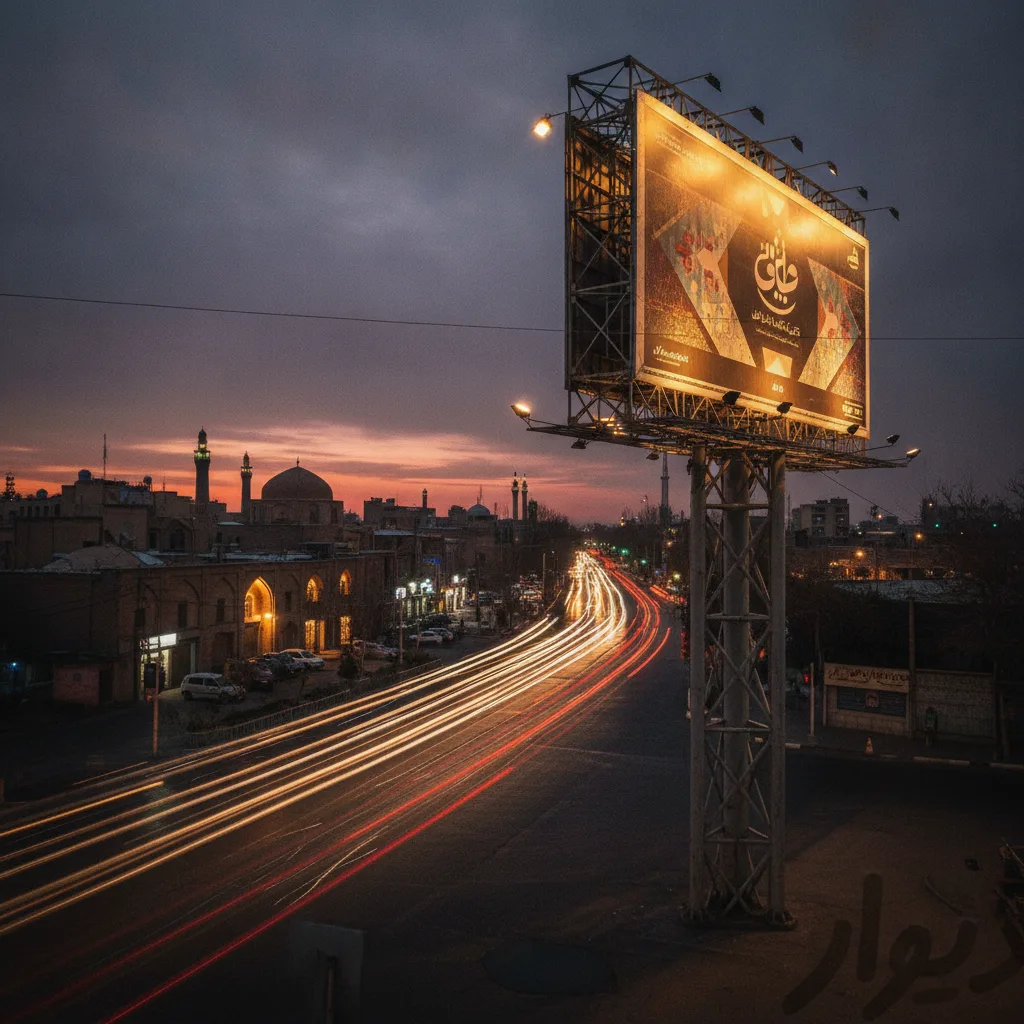
Out-of-home media inventory represents a significant capital investment. Market reporting in Iran shows that structured billboard campaigns can yield up to a 497% return on investment when creative execution maintains high legibility. Media space rental costs vary based on traffic density and city tier. Monthly media space rentals range from approximately $2,500 USD in smaller suburban zones to $35,000 USD for prime expressway locations in major metropolitan areas.
Committing up to $35,000 USD per month for high-traffic inventory makes unreadable creative an expensive mistake. Investing time in artwork scale, visual contrast, and message testing protects your media budget.
A professional billboard design workflow requires 3 to 7 working days. This timeframe covers creative concept development, bilingual layout balance, distance legibility testing, and high-precision 3D municipal submission renders. Proper creative preparation ensures your message communicates effectively the moment media space goes live.
How Art Sun Studio Handles Billboard Campaigns
Founded in 2003 in Isfahan by visual director Ehsan Rezapour, who brings over 25 years of experience across filmmaking, photography, graphic design, and commercial production, Art Sun Studio expanded full studio operations to Dubai in 2018 and Muscat in 2020. Our agency provides comprehensive creative production services across Oman, Iran, and the wider region.
We operate six specialized in-house teams covering Design, Film, Graphic Design, Social Media, Web Design, and AI. By managing 19 core services under one roof across Brand & Design, Photography, Video & Podcast, Web & SEO, Social Media, CGI/VFX & 3D, and AI Services, we maintain quality control across every production phase. When corporate clients partner with us for professional billboard design, our graphic team works directly with our 3D visualization specialists to build accurate site renders for fast municipal approval.
Our studio guides every campaign through a structured 6-step project process: Brief, Proposal, Concept, Production, Review, and Delivery. From establishing legal Arabic visual precedence under Muscat Municipality Ordinance 25/93 to formatting 300 DPI print files for highway unipoles, our team ensures your outdoor media drives clear business results.
Frequently Asked Questions About Billboard Design
How many words can drivers actually read on a highway billboard at 90 km/h?
At 90 km/h, drivers have roughly 3 seconds of viewing time. Billboard copy should be limited to 3 to 5 words maximum, paired with a single product graphic and brand logo, to ensure complete message recall without creating driver distraction.
What are the legal language requirements for outdoor ads in Muscat?
Under Muscat Municipality Local Ordinance 25/93, literary Arabic must be the primary language on all public advertising displays. English text is permitted but must remain secondary in visual scale and layout position relative to the main Arabic copy.
Can billboards be installed on residential buildings or low-rise rooftops in Oman?
No. Muscat Governorate municipal regulations prohibit commercial advertising structures on residential properties or on rooftops of buildings lower than 18 meters in height.
How does designing for digital billboards (DOOH) differ from traditional static vinyl?
Static vinyl requires high-resolution 300 DPI mechanical artwork files and UV-resistant inks. Digital billboards require screen brightness up to 10,000 nits to counter solar glare, along with static 5-second frames rather than fast video animations.
Steps to Launching Your Next Outdoor Campaign
Executing an effective out-of-home ad campaign requires aligning visual legibility, technical artwork specs, and regional legal rules before committing media spend. Follow this action plan when preparing your outdoor campaign:
- Audit Site Speed and Sightlines: Evaluate traffic speeds and viewing distances to establish exact headline word limits and font scaling requirements.
- Establish Bilingual Priority: Set layout hierarchy so Arabic (in Oman) or Persian (in Iran) holds clear visual dominance over secondary English text.
- Perform the Step-Back Test: Test artwork at 15% digital scale or stand 3 meters back from a physical print for 3 seconds to confirm core offer and logo legibility.
- Secure Municipal Approvals Early: Submit 3D structural renders and site photographs through official municipal portals to secure permits before commencing vinyl printing or scheduling digital slots.
If you are planning an upcoming roadside unipole, digital LED, or building facade campaign in Muscat or Isfahan, get in touch with our visual production team. Contact Art Sun Studio to review site-specific 3D renders, verify municipal bilingual compliance, and engineer high-impact creative built for your target market.